1. Introduction
Would customers choose your business after reading your online reviews? Well! today’s customers trust online reviews almost as much as personal recommendations. Before visiting a restaurant, retail store, healthcare clinic, hotel, or automotive dealership, they check Google ratings, customer feedback, and review responses to determine whether a business is trustworthy. Google states that Business Profiles with photos receive more requests for directions and more clicks to their websites than businesses without photos, highlighting the importance of maintaining an active and complete profile. This makes Reputation Management far more than a customer service activity since it has become a key driver of customer trust, local SEO, and business growth.
Google reports that businesses with complete and actively managed Business Profiles receive significantly higher customer engagement. As businesses expand across multiple locations, managing reviews manually becomes increasingly difficult. RightChoice.AI helps organisations streamline online reputation management through AI-powered insights, review response automation, and intelligent analytics that improve customer satisfaction and strengthen local search visibility.
2. Why Reputation Management Has Become a Business Growth Strategy
2.1 The Digital Customer Journey Starts with Reviews
The first interaction many customers have with a business is no longer through a physical store, it begins online. Whether searching for a nearby café, hospital, hotel, or retail outlet, customers compare ratings, read reviews, browse customer photos, and evaluate how businesses respond to feedback before making purchasing decisions. Positive reviews build confidence, while unresolved complaints often discourage potential customers. As a result, customer review management has become a critical factor influencing customer acquisition, trust, and conversion rates.
2.2 Customer Trust Drives Business Performance
Trust is now one of the strongest competitive advantages in today’s digital marketplace. Customers expect businesses to be transparent, responsive, and customer-focused. Businesses that acknowledge reviews, address complaints professionally, and actively engage with customers demonstrate accountability and strengthen their credibility. In contrast, inconsistent review management across multiple branches can create uncertainty and negatively affect overall brand perception. Effective brand reputation management therefore helps businesses build long-term customer relationships while strengthening loyalty and repeat business.
2.3 The Business Cost of Poor Online Reputation
Ignoring online reviews has significant commercial consequences. Negative ratings, delayed responses, and inconsistent customer experiences can reduce customer confidence, weaken local SEO performance, and lower conversion rates. For businesses operating across multiple locations, these challenges become even greater because one poorly managed location can influence perceptions of the entire brand. Without an effective reputation management software solution, organisations often struggle to identify emerging customer issues before they begin affecting sales and brand reputation.
3. Challenges of Reputation Management for Multi-Location Brands
3.1 Managing Multiple Google Business Profiles
Growing businesses often manage dozens or even hundreds of Google Business Profiles, each requiring accurate business information, updated operating hours, images, promotions, and continuous customer engagement. Maintaining consistency manually across every location quickly becomes inefficient and increases the likelihood of outdated or inaccurate information, ultimately affecting customer experience and search visibility.
3.2 Maintaining Brand Consistency Across Every Location
Customers expect the same quality of service regardless of which branch they visit. However, maintaining consistent customer experiences across multiple cities or regions remains a significant challenge. Different store managers may adopt different approaches to customer communication, review responses, and issue resolution, creating inconsistent brand experiences. Successful multi-location reputation management requires standardised processes while allowing sufficient flexibility to personalise interactions at the local level.
3.3 Managing Thousands of Customer Reviews
As organisations grow, customer feedback increases exponentially across Google, Facebook, TripAdvisor, industry-specific review sites, and delivery platforms. Reading, categorising, analysing, and responding to every review manually is both time-consuming and resource-intensive. Valuable insights regarding service quality, product performance, delivery issues, staff behaviour, and customer expectations often remain hidden within thousands of reviews, limiting an organisation’s ability to improve operations efficiently.
3.4 Fragmented Customer Feedback Across Platforms
Customer feedback rarely exists in a single location. Reviews are distributed across search engines, social media platforms, booking websites, delivery applications, and third-party marketplaces. This fragmented information makes it difficult for decision-makers to gain a complete understanding of customer sentiment. Without AI-powered review management software, businesses struggle to consolidate feedback, identify recurring issues, and make timely, data-driven decisions that improve customer experience across every location.
4. The Role of AI in Modern Reputation Management
AI-Powered Sentiment Analysis
Artificial intelligence enables businesses to analyse thousands of customer reviews in real time by identifying positive, neutral, and negative sentiment. Rather than manually reading individual reviews, AI detects recurring themes such as service quality, delivery performance, pricing, or staff behaviour. This allows businesses to identify operational strengths and weaknesses quickly, helping managers make data-driven decisions that improve customer satisfaction and protect brand reputation.
4.1 Intelligent Review Response Automation
Responding promptly to customer reviews is essential for building trust, but managing responses across multiple business locations can be challenging. AI-powered review response automation generates personalised, context-aware replies that maintain a consistent brand voice while reducing manual effort. Faster response times improve customer engagement, demonstrate accountability, and contribute to stronger Google review management and local SEO performance.
4.2 Predictive Reputation Intelligence
Beyond monitoring existing reviews, AI identifies emerging reputation risks before they significantly affect customer perception. By analysing review trends, response rates, customer sentiment, and competitor activity, AI can detect patterns such as increasing complaints or declining satisfaction at specific locations. This predictive capability enables businesses to address issues proactively instead of reacting after their online reputation has already been impacted.
4.3 Centralised Multi-Location Reputation Management
AI simplifies multi-location reputation management by consolidating reviews, ratings, customer feedback, and performance metrics from every business location into a single dashboard. Decision-makers gain complete visibility into location-specific performance, compare branches, benchmark competitors, and monitor reputation trends across the organisation. This centralised approach improves operational consistency, strengthens customer trust, and supports scalable brand reputation management as businesses continue to grow.
5. How Reputation Management Improves Local SEO
5.1 Google Reviews Strengthen Local Search Visibility
Google considers several factors when determining local search rankings, including review quality, review quantity, business relevance, proximity, and customer engagement. Businesses that consistently receive positive reviews and actively interact with customers are more likely to appear in Google’s Local Pack and Google Maps results. Effective Google review management therefore enhances not only customer trust but also local SEO, helping businesses attract high-intent local customers searching for nearby products and services.
5.2 Review Freshness and Response Rates Matter
A high average rating alone is no longer enough to maintain strong online visibility. Search engines increasingly value businesses that receive fresh reviews and respond consistently to customer feedback. Regular customer engagement demonstrates that a business is active, responsive, and committed to service quality. By using review response automation, businesses can maintain timely interactions across every location, improving both customer satisfaction and search engine performance.
5.3 Customer Engagement Drives Local Authority
Every customer interaction contributes to a business’s online authority. Positive reviews, thoughtful responses, updated business information, and active profile management collectively strengthen local relevance. Businesses that continuously engage with their customers establish greater credibility, improve click-through rates, and increase the likelihood of converting online searches into in-store visits.
6. Why Traditional Reputation Management Software Is No Longer Enough
Traditional reputation management software primarily focused on collecting reviews and displaying performance dashboards. While these capabilities remain valuable, they no longer address the growing complexity of managing customer feedback across multiple locations and platforms.
Modern businesses require intelligent solutions that analyse customer sentiment, detect operational issues, benchmark competitors, automate responses, and generate actionable insights. Manual monitoring is often slow, inconsistent, and difficult to scale, particularly for enterprises managing hundreds of locations.
AI-powered review management software bridges this gap by transforming thousands of customer reviews into meaningful business intelligence. Rather than simply monitoring online reputation, organisations can identify trends, improve operational performance, and make strategic decisions based on real customer experiences.
7. How RightChoice.AI Simplifies Multi-Location Reputation Management
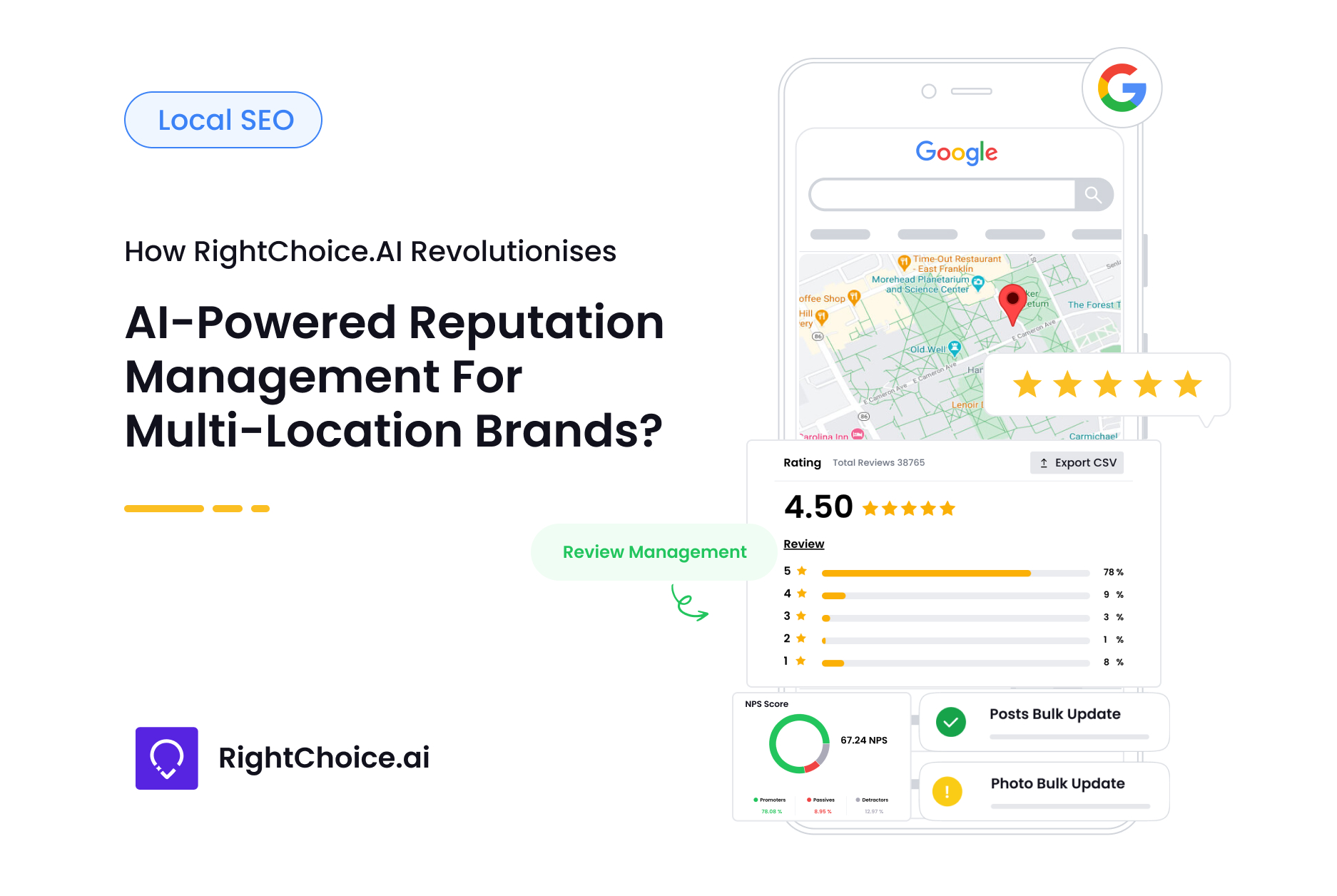
Managing customer feedback across multiple locations requires visibility, consistency, and speed. RightChoice.AI provides a comprehensive AI-powered platform that enables businesses to manage every aspect of their online reputation from one centralised dashboard.
- Centralised Reputation Dashboard: Track reviews, ratings, response performance, customer sentiment, and location-specific insights across all business locations through a single, easy-to-use interface.
- AI Review Response Automation: Generate personalised, context-aware responses within seconds while maintaining a consistent brand voice. Automated responses improve customer engagement and significantly reduce manual workload.
- Advanced Sentiment Analysis: AI automatically identifies recurring customer concerns, positive experiences, and operational challenges, allowing businesses to prioritise improvements that have the greatest impact on customer satisfaction.
- Competitor Benchmarking: Compare review performance, response rates, customer sentiment, and local visibility against competitors to identify strengths, weaknesses, and new growth opportunities.
- Google Review Management: Monitor Google Business Profiles, track review trends, improve profile engagement, and strengthen local SEO through continuous optimisation.
- Enterprise-Level Multi-Location Management: Whether managing 10 or 1,000 business locations, RightChoice.AI provides scalable tools that ensure consistent customer engagement and standardised reputation management across the entire organisation.
8. Benefits of AI-Powered Reputation Management
Businesses implementing AI-driven online reputation management experience measurable improvements across several key areas.
- Stronger customer trust through faster and more consistent review responses.
- Improved local SEO performance driven by higher engagement and active Google Business Profiles.
- Reduced manual effort through intelligent automation and AI-powered workflows.
- Better operational decision-making using real-time customer sentiment and review analytics.
- Increased customer retention by resolving concerns before they escalate.
- Enhanced brand reputation management through consistent experiences across every business location.
By combining automation with actionable insights, AI allows businesses to shift from reactive problem-solving to proactive reputation building.
9. Best Practices for Effective Reputation Management
Technology alone cannot build a strong reputation. Businesses should adopt a structured strategy that combines AI with customer-centric practices.
- Encourage Genuine Customer Reviews: Request reviews immediately after positive customer experiences through email, SMS, QR codes, or post-purchase follow-ups while complying with platform guidelines.
- Respond to Every Review: Every review deserves acknowledgement. Prompt responses demonstrate that customer feedback is valued and contribute to stronger customer relationships.
- Monitor Reputation Continuously: Regularly analyse customer sentiment, review trends, response times, and location performance to identify emerging opportunities and operational challenges.
- Turn Negative Feedback into Improvement Opportunities: Negative reviews should be viewed as valuable customer insights. Addressing recurring complaints enables businesses to improve products, services, and operational processes.
- Measure Performance Across Every Location: Track important metrics such as average ratings, review growth, response rates, customer sentiment, and local search visibility to ensure consistent performance throughout the organisation.
10. The Future of Reputation Management Is AI-Driven
As customer expectations continue to evolve, businesses can no longer rely solely on manual review monitoring. Artificial intelligence is redefining Reputation Management by enabling predictive sentiment analysis, intelligent customer engagement, automated workflows, and data-driven decision-making.
Future innovations will include hyper-personalised AI review responses, predictive reputation scoring, voice-search optimisation, and deeper integration between customer experience and marketing analytics. Organisations that embrace AI today will be better positioned to strengthen customer trust, improve operational efficiency, and outperform competitors in increasingly competitive local markets.
11. Conclusion
Reputation Management is no longer just about responding to online reviews, it is about building trust, improving customer experiences, and strengthening digital visibility across every business location. For organisations managing multiple branches, AI provides the scalability needed to monitor customer sentiment, automate review responses, identify operational improvements, and enhance local SEO without increasing manual effort. With advanced online reputation management, customer review management, intelligent analytics, and review response automation, RightChoice.AI empowers businesses to transform customer feedback into a strategic growth engine. As digital interactions continue to shape purchasing decisions, investing in AI-powered reputation management will be essential for businesses seeking sustainable growth, stronger customer relationships, and long-term competitive advantage.