1.0 Indonesia’s Fast-Growing QSR Market and Digital Consumer Shift
1.1 Why Indonesia Has Become Southeast Asia’s Fastest-Growing QSR Opportunity
Indonesia has become one of Southeast Asia’s most attractive destinations for Quick Service Restaurant (QSR) investment and expansion. Supported by a population exceeding 280 million people, rapid urbanisation, rising disposable incomes, and an increasingly digital economy, the country offers exceptional opportunities for restaurant operators seeking scale and growth. The expansion of shopping malls, transportation infrastructure, and delivery ecosystems has transformed fast food from an occasional indulgence into a regular component of urban lifestyles.
Young consumers are driving much of this demand. Indonesia possesses one of the youngest populations in Asia, and digitally connected consumers increasingly prioritise convenience, affordability, and accessibility when choosing dining options. This has accelerated demand for fast-service dining concepts that can deliver consistent experiences across multiple locations.
1.2 Urbanisation, Rising Middle-Class Income, and Convenience Dining Trends
Indonesia’s growing middle class has significantly altered consumer behaviour within the food sector. Longer commuting times, busier work schedules, and increased workforce participation have driven demand for convenient dining solutions that fit modern lifestyles. Consumers increasingly prefer businesses capable of providing quick preparation times, seamless ordering experiences, and reliable delivery performance.
Cities such as Jakarta, Surabaya, Bandung, Medan, and Makassar continue witnessing strong QSR expansion because of increasing purchasing power and higher consumer spending on convenience services. These cities are becoming major battlegrounds for customer attention and local search visibility.
1.3 How Mobile-First Consumers Are Transforming Restaurant Discovery
Indonesia is one of the world’s most mobile-first economies. Consumers increasingly discover restaurants through smartphones rather than traditional advertising channels. Before placing an order or visiting an outlet, customers frequently compare Google ratings, customer photographs, reviews, and delivery experiences.
This shift means that digital reputation has become as important as physical location. Businesses that maintain strong Google visibility often enjoy higher customer trust and stronger conversion rates.
2.0 The Rise of Google Search and Maps in Indonesia’s Food Industry
2.1 How Indonesian Consumers Use Google Before Choosing Restaurants
The role of Google within Indonesia’s restaurant ecosystem has expanded dramatically during recent years. Google Search and Google Maps now function as the primary discovery channels for millions of Indonesian consumers looking for restaurants, cafés, and takeaway options.
Before making dining decisions, consumers increasingly evaluate businesses using star ratings, customer reviews, photographs, delivery experiences, and menu previews. This behaviour has transformed Google Business Profiles into powerful digital storefronts capable of directly influencing customer acquisition and revenue generation.
Businesses maintaining stronger ratings and more active customer engagement often outperform competitors in both customer trust and local visibility.
2.2 The Growing Importance of “Near Me” and Delivery-Based Searches
One of the strongest indicators of changing consumer behaviour is the continued growth of local intent searches across Indonesia. Queries such as “fast food near me,” “pizza delivery near me,” “restaurants open now,” “coffee shops near me,” and “halal burgers near me” continue increasing because they represent immediate purchasing intent.
According to Google local search data, approximately 76% of consumers conducting local searches visit businesses within 24 hours, while approximately 28% complete purchases on the same day.
This means visibility within Google Maps SEO directly influences customer acquisition and market share growth. For multi-location restaurant chains, appearing prominently within local search results can create substantial competitive advantages, particularly in highly competitive markets such as Jakarta and Surabaya.
The rise of local SEO for restaurants has therefore become one of the most important strategic priorities within Indonesia’s QSR sector.
2.3 Why Google Business Profiles Have Become Digital Storefronts for QSR Brands
Google Business Profiles have evolved far beyond simple directory listings. Today they serve as complete digital storefronts where consumers evaluate businesses before engaging with them. Customers increasingly examine Google ratings, customer images, menu information, review responses, delivery experiences, operating hours, and overall customer sentiment before making decisions.
Businesses maintaining active profiles often benefit from stronger customer trust and higher conversion rates because profile activity signals operational relevance and customer engagement. Google itself recommends that businesses regularly update information, respond to reviews, upload photographs, and maintain profile accuracy to improve local visibility.
For Indonesia’s expanding multi-location restaurant industry, maintaining optimised Google Business Profiles is becoming essential for sustainable growth and stronger local search rankings.
3.0 Review Benchmarks Across Indonesia’s QSR Industry
3.1 Review Volume Growth and Digital Engagement Trends
Customer review ecosystems have expanded significantly across Indonesia’s restaurant sector as consumers increasingly share dining experiences publicly through Google reviews and digital platforms. The rise of online restaurant reviews reflects increasing digital participation among Indonesian consumers. Reviews are no longer considered optional feedback mechanisms but rather important components of the customer experience itself. The below graph demonstrated significant differences in customer engagement across the five benchmarked QSR brands. Brand A recorded the highest review volume with 568.8K reviews, followed by Brand B (388.4K), Brand C (270.3K), Brand D (133.6K), and Brand E (67.2K) during the tracking period. The findings indicate that brands with larger and more active review ecosystems tend to achieve stronger digital visibility and greater customer interaction. High review volumes also reflect stronger consumer participation, which can positively influence local search rankings, enhance online credibility, and strengthen competitive positioning within increasingly digital and location-based food service markets
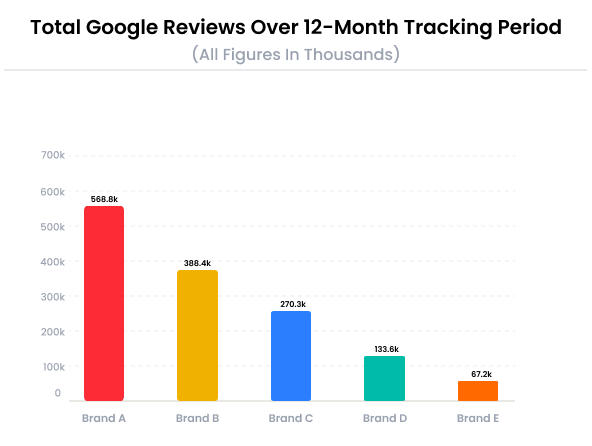
Businesses generating higher review volumes often achieve stronger local visibility because Google increasingly interprets customer engagement as a signal of relevance and popularity. This creates significant opportunities for brands capable of encouraging customer feedback while simultaneously maintaining operational consistency.
As the Indonesian food service industry continues expanding, review generation will likely become one of the most important indicators of customer engagement and market relevance.
3.2 Average Ratings as Indicators of Customer Satisfaction
Average ratings provide valuable insights into operational quality and customer satisfaction performance. Businesses maintaining higher ratings across locations generally demonstrate stronger operational discipline, staff training standards, and customer service consistency. Conversely, significant rating fluctuations often indicate problems involving food quality, delivery performance, customer service, or operational execution. Consumers increasingly use ratings as shortcuts for trust evaluation. Businesses with stronger Google ratings often experience higher click-through rates and stronger conversion performance within search results. Businesses maintaining ratings above 4.0 stars are substantially more likely to attract customer engagement than lower-rated competitors. Within Indonesia’s competitive QSR industry, maintaining positive ratings is therefore becoming a strategic growth objective rather than simply a branding metric.
3.3 Review Velocity and Its Impact on Local Search Visibility
Review velocity refers to the frequency with which businesses receive new customer reviews. Fresh customer feedback signals relevance, popularity, and operational activity to Google’s ranking algorithms. Businesses generating continuous review activity often experience stronger Google Maps rankings and improved visibility within local search results. The graph highlighted notable differences in review generation trends and customer engagement across the benchmarked QSR brands. Brand C maintained the strongest review momentum, generating approximately 1.9K–2.9K new reviews per month, followed closely by Brand D with 1.1K–2.8K monthly reviews, indicating consistent customer interaction and sustained digital visibility. Brand E experienced a significant quarterly surge of approximately 4.8K additional reviews, reflecting increased customer engagement and improved brand perception during the period. In contrast, Brand A demonstrated declining review momentum and lower recent ratings despite possessing the largest historical review base, suggesting that maintaining continuous customer engagement is more important than relying on accumulated reputation alone.
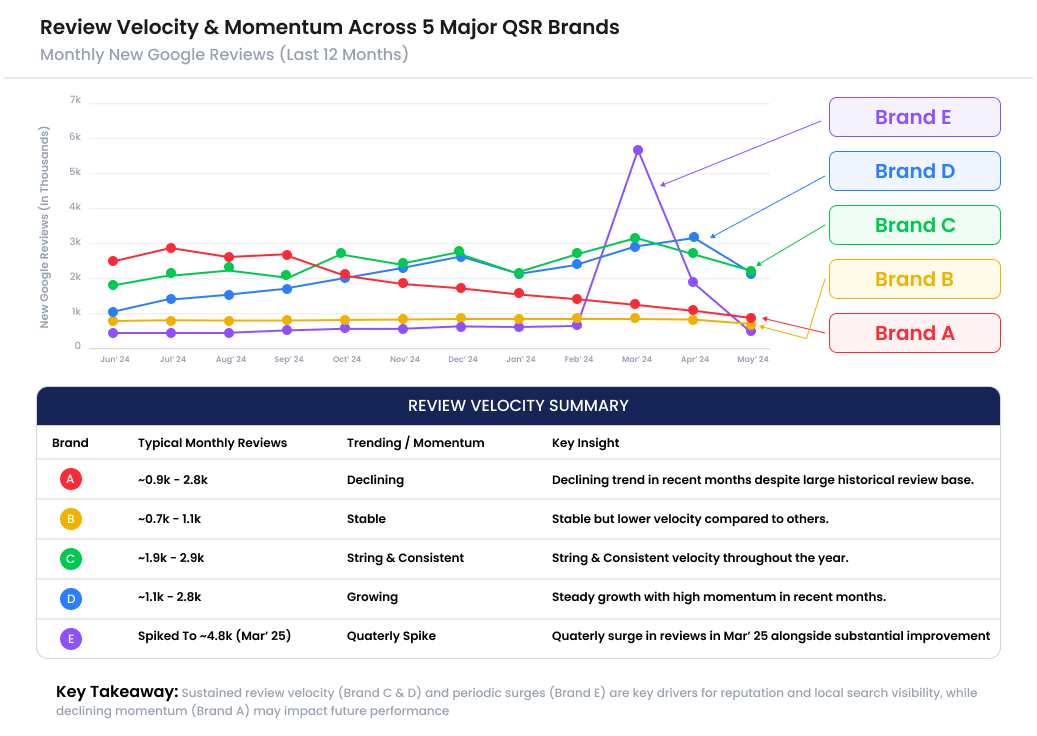
Review velocity has therefore become one of the strongest indicators of digital health within the restaurant sector. For Indonesian restaurant operators competing for visibility within densely populated urban markets, consistent customer engagement often translates directly into stronger local visibility and customer acquisition opportunities.
4.0 Customer Sentiment Trends Across Indonesian Fast-Food Consumers
4.1 What Drives Positive Customer Experiences in Indonesia’s QSR Market
Positive customer sentiment within Indonesia’s fast-food industry is primarily driven by convenience, affordability, delivery speed, food quality, and operational consistency.
Consumers increasingly reward businesses capable of delivering reliable experiences regardless of location or ordering channel. Positive reviews frequently mention friendly staff interactions, accurate orders, fast delivery times, food freshness, and ease of ordering through digital channels. Businesses consistently delivering these experiences often benefits from stronger customer loyalty, higher repeat purchase rates, and improved online reputation.
4.2 Common Customer Complaints Affecting QSR Reputation
Negative sentiment across Indonesia’s QSR market frequently highlights issues involving delayed deliveries, incorrect orders, food temperature concerns, missing items, packaging problems, and inconsistent customer service.
Many of these issues originate from increasing complexity within food delivery operations and higher transaction volumes. Public reviews ensure these operational weaknesses become immediately visible to future customers, making reputation management increasingly important for long-term success.
4.3 How Service Quality Influences Customer Loyalty and Repeat Purchases
Customer loyalty increasingly depends on operational reliability rather than marketing expenditure alone. Businesses consistently delivering positive experiences often generate stronger repeat purchase behaviour and higher customer retention rates. This makes operational excellence one of the strongest competitive advantages within Indonesia’s highly competitive restaurant industry.
5.0 Delivery Culture and Operational Challenges in Indonesia’s QSR Ecosystem
5.1 The Influence of Food Delivery Platforms on Customer Expectations
Indonesia’s rapid adoption of online food delivery services has fundamentally transformed customer expectations regarding convenience and service quality.
Consumers increasingly expect fast deliveries, accurate orders, real-time tracking, and restaurant-quality food delivered directly to their homes.
This creates substantial operational pressure for QSR operators because customer satisfaction increasingly depends on both restaurant execution and delivery performance.
5.2 Managing Delivery Speed, Order Accuracy, and Food Quality
Balancing delivery speed with food quality represents one of the biggest operational challenges facing Indonesia’s quick service restaurant industry. The findings demonstrated a consistent gap between dine-in and delivery experiences across the benchmarked QSR brands, highlighting delivery performance as a key operational challenge. Brand C achieved the strongest dine-in rating of 4.7, although its delivery rating declined to 3.9, indicating that service quality was not fully replicated through delivery channels. Brand B maintained relatively balanced performance, recording 4.7 for dine-in and 4.2 for delivery, suggesting stronger operational consistency. Brand D experienced the largest disparity, with takeaway services rated 4.5 compared with only 3.0 for delivery, while Brand A similarly recorded 4.3 for dine-in and 3.0 for delivery. These findings suggest that customers consistently perceive delivery services less favourably than in-store experiences, primarily due to issues related to delivery speed, order accuracy, food condition, and fulfilment reliability.
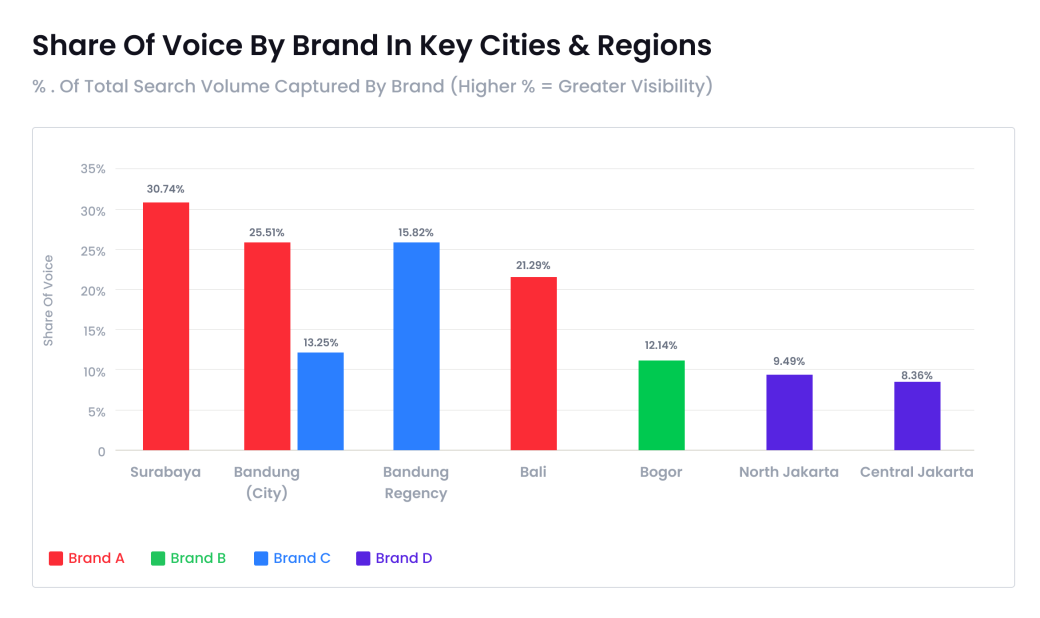
Delays, incorrect orders, packaging failures, and food temperature concerns frequently become sources of negative customer sentiment and poor reviews. Businesses capable of optimising operational workflows while maintaining consistency gain significant advantages in customer trust and reputation performance.
5.3 Balancing High Transaction Volumes with Operational Consistency
As brands continue expanding aggressively across Indonesia, maintaining operational consistency becomes increasingly difficult.
Staff training, quality assurance systems, operational monitoring, and customer feedback management become essential for preserving brand reputation at scale.
Without operational discipline, rapid expansion can quickly damage online reputation, customer trust, and long-term growth potential within Indonesia’s highly competitive QSR market.
6.0 Local SEO and Google Maps Are Becoming Competitive Battlegrounds
6.1 Why Google Maps Visibility Matters for Multi-Location QSR Brands
As Indonesia’s restaurant sector becomes increasingly crowded, Google Maps visibility has emerged as one of the most important competitive advantages for multi-location QSR operators. Consumers searching for dining options often make decisions within seconds based on ratings, proximity, customer reviews, and visual content displayed directly within search results.
Unlike traditional advertising campaigns that target broad audiences, local search captures consumers with immediate purchasing intent. Searches such as “best fast food near me,” “burger delivery Jakarta,” “fried chicken near me,” “halal restaurant near me,” and “coffee shop near me” indicate that customers are actively looking to purchase rather than merely browsing options. This makes local SEO for restaurants one of the highest-return marketing investments within the QSR
For Indonesian QSR brands operating across Jakarta, Surabaya, Bandung, Medan, Bali, Semarang, and Makassar, maintaining strong visibility for location-based searches has become essential for sustaining market share growth.
6.2 The Relationship Between Reviews, Ratings, and Local Rankings
Customer reviews and ratings increasingly influence both customer trust and search visibility. Google’s local ranking algorithms evaluate multiple factors, including relevance, distance, prominence, customer engagement, review quantity, review freshness, and overall sentiment performance.
Businesses maintaining strong Google ratings, active customer engagement, and high review velocity often achieve stronger visibility within local search results. Positive reviews signal trust and reliability to both consumers and Google’s algorithms, while consistent customer interaction indicates business activity and relevance.
For Indonesia’s rapidly growing restaurant industry, customer experience is therefore no longer separate from digital marketing performance. Instead, operational excellence directly contributes to online visibility and customer acquisition.
6.3 Geo-Targeted Search Behaviour Across Jakarta and Tier-2 Cities
Consumer search behaviour varies significantly across Indonesia’s major urban centres and emerging cities. Jakarta remains one of Southeast Asia’s most competitive food markets, where consumers have access to thousands of restaurant choices across multiple categories and price points.
BThe findings demonstrated significant regional variations in local search visibility, indicating that market leadership differed across Indonesia’s key cities. Brand A achieved its strongest Share of Voice in Surabaya (30.74%), followed by Bandung (25.51%) and Bali (21.29%), reflecting a dominant presence in several high-growth regional markets. Brand D recorded its highest visibility in Bandung Regency (15.82%) and Bandung City (13.25%), while Brand C performed best in Bogor (12.14%), suggesting strong local market penetration despite operating fewer outlets. Brand E achieved comparatively stronger visibility in North Jakarta (9.49%) and Central Jakarta (8.36%), indicating competitive performance within the capital. Notably, Brand B maintained superior visibility across most competitive search categories despite operating a smaller store network than several competitors. This finding suggests that digital optimisation, review quality, and local SEO strategies contribute more significantly to Share of Voice than outlet density alone.
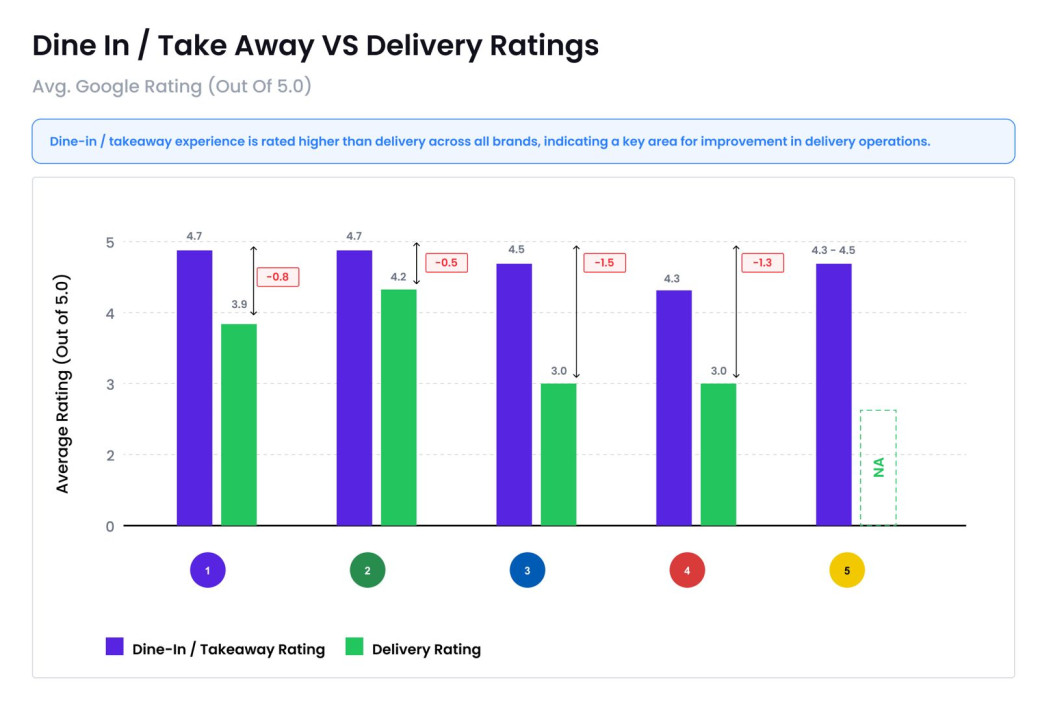
The increasing popularity of location-based restaurant searches in Tier-2 cities highlights the importance of regional SEO strategies and local reputation management initiatives. Businesses optimising their presence for city-specific search queries frequently outperform competitors relying solely on national marketing campaigns.
7.0 Reputation Management Is Becoming a Strategic Growth Function
7.1 Why Review Response Rates Influence Customer Trust
Modern consumers increasingly expect businesses to acknowledge customer feedback publicly and respond to complaints transparently. For Indonesia’s quick service restaurant industry, where customer interactions occur at extremely high volumes, review responses create valuable opportunities for service recovery and reputation improvement. Even when operational issues occur, transparent communication often prevents negative experiences from escalating into long-term reputation damage.
Customers increasingly evaluate not only what businesses do well but also how businesses respond when problems arise.
7.2 The Business Impact of Active Customer Engagement
Active customer engagement generates benefits extending beyond customer satisfaction alone. Businesses maintaining structured review management programmes often identify operational weaknesses more quickly than competitors relying solely on internal reporting systems.
Customer reviews frequently highlight recurring issues involving food temperature, packaging quality, delivery speed, employee behaviour, and order accuracy. Monitoring these trends enables businesses to implement improvements proactively rather than reactively.
Google also rewards active engagement. Businesses regularly responding to reviews signal profile activity and customer attentiveness, both of which contribute positively to local SEO performance and Google Business Profile optimisation.
For Indonesian QSR brands operating at scale, customer engagement therefore becomes both a customer service initiative and a business growth strategy.
7.3 Moving From Reactive Complaint Handling to Proactive Reputation Management
Traditional customer service models often focused on resolving complaints individually after issues had already escalated. Modern reputation management adopts a more proactive approach by identifying patterns within customer sentiment before operational issues become widespread.
Businesses increasingly monitor customer feedback continuously to identify recurring complaint categories, benchmark competitors, and detect emerging risks. This approach enables operational teams to address root causes rather than symptoms.
Artificial intelligence increasingly supports these processes through automated sentiment analysis, review categorisation, and competitor benchmarking capabilities.
As Indonesia’s fast food market becomes increasingly competitive, businesses adopting proactive reputation management strategies will likely outperform competitors relying solely on reactive customer service approaches.
8.0 The Future of Indonesia’s QSR Industry Will Be AI-Driven
8.1 AI-Powered Sentiment Analysis and Review Intelligence
Artificial intelligence is rapidly transforming how restaurant businesses understand customer behaviour and operational performance. Traditional customer surveys and manual review monitoring methods are increasingly being replaced by AI-powered analytics capable of processing thousands of reviews within seconds.
Modern AI systems can identify positive and negative sentiment patterns, detect recurring operational issues, benchmark competitors, and prioritise areas requiring improvement.
For large multi-location restaurant operators, these capabilities provide substantial advantages because they enable businesses to make decisions based on customer feedback data rather than assumptions.
As Indonesia’s restaurant technology market continues evolving, AI-driven reputation management solutions will likely become standard operational infrastructure rather than optional competitive advantages.
8.2 Multi-Location Reputation Monitoring for Growing Restaurant Chains
Managing reputation across multiple cities and hundreds of outlets creates significant complexity for restaurant operators. Individual store managers often lack visibility into broader customer sentiment trends, making it difficult to identify systemic issues affecting the wider organisation.
Centralised reputation management platforms enable businesses to compare locations, identify underperforming outlets, monitor competitors, and benchmark customer satisfaction metrics across regions. This capability becomes increasingly valuable as Indonesian restaurant chains expand aggressively into emerging markets and Tier-2 cities.
Businesses capable of identifying issues early can allocate resources more effectively and maintain stronger customer trust across networks.
8.3 Data-Driven Decision Making Through Customer Feedback Analytics
Customer reviews now represent one of the richest operational datasets available to restaurant operators. Every review contains insights regarding product quality, service performance, employee interactions, delivery execution, and customer expectations.
Businesses capable of transforming this feedback into actionable intelligence gain significant competitive advantages over organisations relying solely on traditional reporting systems.
Data-driven businesses can identify trends earlier, improve operational consistency more effectively, and optimise customer experiences continuously.
As review ecosystems continue expanding, customer feedback analytics will likely become one of the most valuable business intelligence resources within Indonesia’s QSR industry.
9.0 Strategic Recommendations for Indonesia’s QSR Industry
9.1 Building Operational Consistency Across Expanding Store Networks
As Indonesian QSR operators continue expanding nationally, maintaining operational consistency must remain a strategic priority. Customers increasingly expect identical experiences regardless of whether they order from Jakarta, Surabaya, Bandung, Bali, or Medan.
Standardised training programmes, operational audits, quality assurance systems, and structured feedback loops become essential for preserving customer trust at scale.
Businesses unable to maintain consistency often experience significant challenges in sustaining positive sentiment as expansion accelerates.
9.2 Leveraging Google Reviews for Local SEO Growth
Google reviews should no longer be viewed solely as customer feedback mechanisms. Instead, they should be treated as strategic assets capable of improving visibility, customer acquisition, and long-term growth. Businesses should actively encourage customers to leave reviews, maintain high response rates, monitor sentiment patterns, and integrate customer insights into operational improvement programmes.
This approach simultaneously strengthens online reputation management, Google Maps rankings, and customer loyalty.
9.3 Why Reputation Intelligence Will Define Future Market Leaders
Indonesia’s QSR industry is rapidly entering a reputation economy where customer sentiment, local search visibility, operational consistency, and digital engagement determine long-term competitiveness.
Businesses capable of monitoring customer feedback proactively, identifying operational weaknesses quickly, and engaging with customers effectively will increasingly outperform competitors relying solely on traditional advertising strategies.
Platforms such as RightChoice.AI help multi-location restaurant brands transform customer feedback into actionable intelligence through review monitoring, sentiment analysis, competitor benchmarking, local ranking tracking, and AI-powered reputation management solutions.