



1.0 India’s QSR Industry Is Entering a Reputation Economy
1.1 The Indian QSR Market Is Growing Faster Than Ever
India’s Quick Service Restaurant (QSR) industry has become one of the fastest-growing consumer sectors in the country. Rapid urbanisation, changing lifestyles, rising disposable income, app-based food delivery growth, and smartphone penetration have significantly transformed consumer dining behaviour.
The expansion of delivery ecosystems and mobile-first ordering behaviour has accelerated digital discovery within the food industry. Consumers now increasingly search for restaurants through Google Search and Google Maps before placing orders or visiting physical outlets. According to Google’s local search insights, “near me” searches continue expanding globally because consumers increasingly prioritise convenience and accessibility in purchasing decisions.
Google Business Profiles now function as digital storefronts where consumers evaluate ratings, reviews, customer photos, menus, hygiene standards, opening hours, and delivery experiences before making decisions.
1.2 Why Google Reviews Have Become a Competitive Advantage
Google reviews have evolved into one of the most powerful reputation indicators within the restaurant industry. Customers now publicly evaluate businesses through ratings, reviews, photos, and delivery feedback, meaning operational performance is continuously visible to potential consumers. This transformation has made digital reputation a measurable competitive advantage rather than simply a customer feedback channel.
Research indicates nearly 76% of consumers conducting “near me” searches visit businesses within 24 hours, highlighting how strongly local visibility influences restaurant discovery and purchasing behaviour.
Within India’s QSR ecosystem, businesses maintaining stronger customer engagement and review management strategies increasingly outperform competitors in Google Maps visibility, customer trust, and local SEO performance. Consumers regularly compare ratings, customer photos, recent reviews, and operational feedback before making decisions, meaning businesses with stronger sentiment performance are more likely to attract new customers consistently.
1.3 Objective of the Industry Analysis
To understand how customer sentiment and digital engagement are influencing India’s QSR landscape, a 12-month industry analysis was conducted across major fast-food chains operating nationally. The study examined critical performance indicators such as review growth, average ratings, review velocity, customer sentiment, complaint categories, response rates, and ranking fluctuations.
2.0 Digital Visibility Is Reshaping the QSR Industry
2.1 Google Maps Has Become the New Restaurant Discovery Platform
Restaurant discovery behaviour has changed dramatically over the last several years. Consumers no longer rely only on advertising campaigns, mall visibility, or outdoor branding to discover restaurants. Instead, Google Maps and local search results increasingly function as the primary discovery platforms for QSR businesses.

Google Business Profiles now operate as digital shopfronts where customers evaluate ratings, reviews, customer photos, menu previews, opening hours, and delivery experiences before interacting with businesses. This means local search visibility directly affects customer acquisition, footfall, delivery conversions, and long-term brand perception.
Businesses appearing prominently within Google Maps results gain significant competitive advantages because local visibility strongly influences customer decision-making. Consumers increasingly prefer restaurants with higher ratings, stronger review engagement, and more active customer interaction because these signals create trust and operational credibility.
2.2 “Near Me” Searches Are Driving Customer Intent
One of the strongest drivers of digital visibility growth within the QSR industry is the rapid increase in “near me” searches. Searches such as “food near me,” “food delivery near me,” “restaurants open now”continue increasing because consumers expect immediate convenience and fast service availability.
Research indicates that approximately 28% of local searches result in purchases within the same day, demonstrating how directly local SEO affects restaurant revenue and customer acquisition. This has created a highly competitive local search environment where QSR brands must continuously optimise digital visibility to remain competitive within high-intent search categories.
2.3 Mobile Search Behaviour Is Changing Consumer Decisions
India’s mobile-first digital ecosystem has significantly accelerated restaurant discovery through search platforms. Most restaurant-related searches now originate from smartphones, meaning consumers frequently search while commuting, travelling, working, or ordering food from home.
Because of this behavioural shift, customers increasingly expect real-time information, accurate ratings, updated delivery availability, and trustworthy customer feedback. Businesses failing to maintain strong digital credibility risk losing visibility even if they possess extensive physical outlet networks or strong market recognition.
This shift demonstrates that digital visibility is no longer simply a marketing function. Instead, it has become directly connected to operational quality, customer satisfaction, and search visibility.
3.0 Review Benchmarks Reveal Major Industry Trends
3.1 Review Volume Reflects Digital Customer Engagement
One of the strongest indicators of customer interaction within the QSR industry is review activity. Large restaurant chains now accumulate hundreds of thousands of customer reviews across nationwide outlet networks, reflecting how deeply integrated digital feedback has become within India’s restaurant ecosystem. Brand B generated the highest review volume at more than 610,000 reviews across 1,100+ outlets, while Brand A accumulated over 560,000 reviews nationwide. Brand C recorded more than 350,600 reviews across 1,020+ locations, followed by Brand D with 320,000+ reviews and Brand E with approximately 102,000 reviews.
This level of review activity significantly influences local search visibility because Google’s algorithm increasingly rewards businesses generating continuous engagement. Brands receiving steady customer feedback tend to maintain stronger visibility within Google Maps and local search results.
Businesses actively encouraging customer engagement generate stronger digital visibility over time because fresh reviews signal ongoing relevance, popularity, and operational activity to Google’s local ranking systems.
3.2 Average Ratings Reflect Operational Consistency
Average star ratings revealed significant operational insights across the industry. Some businesses maintained relatively stable customer satisfaction levels, while others demonstrated wider rating fluctuations between locations. This indicates that operational consistency remains one of the biggest challenges within large-scale QSR operations.
Customers increasingly expect identical service experiences regardless of outlet location, city, or delivery platform. Inconsistencies involving food quality, order accuracy, hygiene, packaging, or staff behaviour can rapidly affect digital reputation because customer feedback becomes immediately visible across Google’s ecosystem.
Importantly, the analysis revealed that high review volume alone does not guarantee positive customer trust. Some businesses receiving substantial customer engagement still struggled with negative sentiment because operational weaknesses outweighed engagement advantages. Brand B generated the highest review volume at 610,000+ reviews, showing that delivery-focused QSR models drive significantly higher digital engagement as shown in table.
3.3 Review Velocity Is Becoming an SEO Signal
Review velocity: the frequency at which businesses receive new reviews has become one of the most important local SEO signals within the restaurant industry. Businesses generating continuous customer interaction often achieve stronger Google Maps visibility and better local rankings because Google increasingly rewards active engagement.
Fresh reviews signal relevance, popularity, and operational activity. Businesses maintaining consistent review generation therefore benefit from increased visibility for “near me” searches and local discovery queries.
4.0 Brands Analysis
| Brand | Total Reviews | Locations | Negative Sentiment | Response Rate | Key Operational Insight |
| Brand A | 560,000+ | Large nationwide presence | 26.90% | 74.27% | Strong market visibility but inconsistent service quality and delayed orders affect customer experience. |
| Brand B | 610,000+ | 1,100+ | 52% | 29.02% | Extremely high engagement and delivery demand, but operational inefficiencies and packaging complaints reduce sentiment stability. |
| Brand C | 350,600+ | Major metro presence | 47% | 22.72% | Better response engagement and customer trust contribute to stronger ranking consistency across urban markets. |
| Brand D | 320,000+ | 900+ | 49% | 18.96% | Expansion supports visibility growth, but order accuracy and waiting time complaints impact sentiment. |
| Brand E | 102,000+ | Urban-focused outlets | 52.15% | 3.19% | Weak review engagement and inconsistent service quality negatively affect digital trust and local SEO stability. |
Table 1: Brand Insights
5.0 Customer Sentiment Highlights Industry-Wide Operational Challenges
5.1 Positive Sentiment Is Driven by Convenience and Consistency
Positive customer reviews within the QSR industry generally focused on convenience, affordability, reliable delivery experiences, menu familiarity, and operational consistency. Customers particularly appreciated businesses maintaining predictable service quality and accurate order fulfilment across locations.
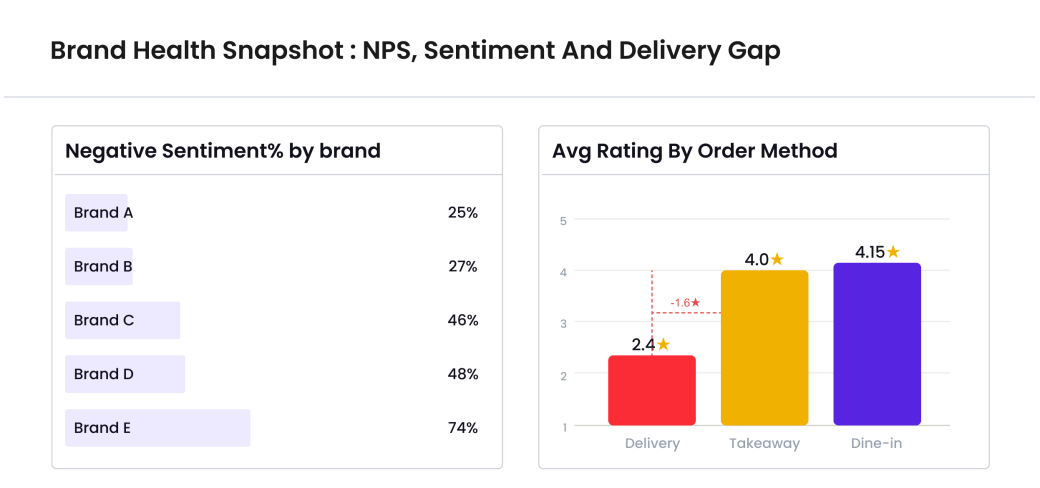
This highlights an important industry insight since operational reliability increasingly matters more than aggressive advertising campaigns. Brand A recorded the lowest negative sentiment at 25%, indicating stronger customer satisfaction and operational consistency. Better service quality and customer engagement likely contributed to healthier brand perception and stronger consumer trust. Moreover, Brand B maintained relatively low negative sentiment at 27%, showing balanced operational performance and customer experience. The brand demonstrates stronger reputation stability compared to competitors facing significantly higher dissatisfaction and delivery-related complaints.
Brand C showed 46% negative sentiment, indicating major operational challenges affecting customer satisfaction. Higher complaint levels suggest issues related to delivery efficiency, order quality, or inconsistent customer service experiences across outlets. The data demonstrates a clear negative correlation between reviews and rankings as negative reviews increase, average ratings and digital visibility tend to decline. Businesses maintaining stronger sentiment and customer engagement generally achieve better Google rankings, stronger trust, and higher consumer interaction across delivery, dine-in, and takeaway channels.

5.2 Negative Reviews Expose Operational Weaknesses
Negative sentiment analysis revealed several recurring operational problems affecting the QSR industry overall. Common complaint categories included delayed deliveries, incorrect orders, packaging issues, poor food temperature, long waiting times, hygiene concerns, and inconsistent staff behaviour. Moreover, Brand D recorded 48% negative sentiment, reflecting substantial dissatisfaction among customers. Operational inconsistencies, waiting times, or fulfilment issues likely contributed toward weaker customer perception and declining overall brand health performance. Moreover, Brand E experienced the highest negative sentiment at 74%, highlighting severe customer dissatisfaction and operational inefficiencies. Poor delivery experiences, service inconsistency, and weak customer engagement significantly damaged overall brand perception and trust.
Delivery-related complaints were especially common because modern QSR operations increasingly depend on high-volume app-based fulfilment systems. As delivery ecosystems continue expanding, maintaining operational consistency across hundreds of locations becomes increasingly challenging.
6.0 Reputation Management Is Becoming a Core Growth Strategy
6.1 Review Response Rates: Separate Industry Leaders
One of the most important differentiators identified within the analysis was customer review response behaviour. Some businesses actively responded to large percentages of customer reviews consistently, while others demonstrated minimal engagement despite receiving substantial feedback volumes.
Customers increasingly expect businesses to acknowledge complaints publicly, demonstrate accountability, and resolve issues transparently.
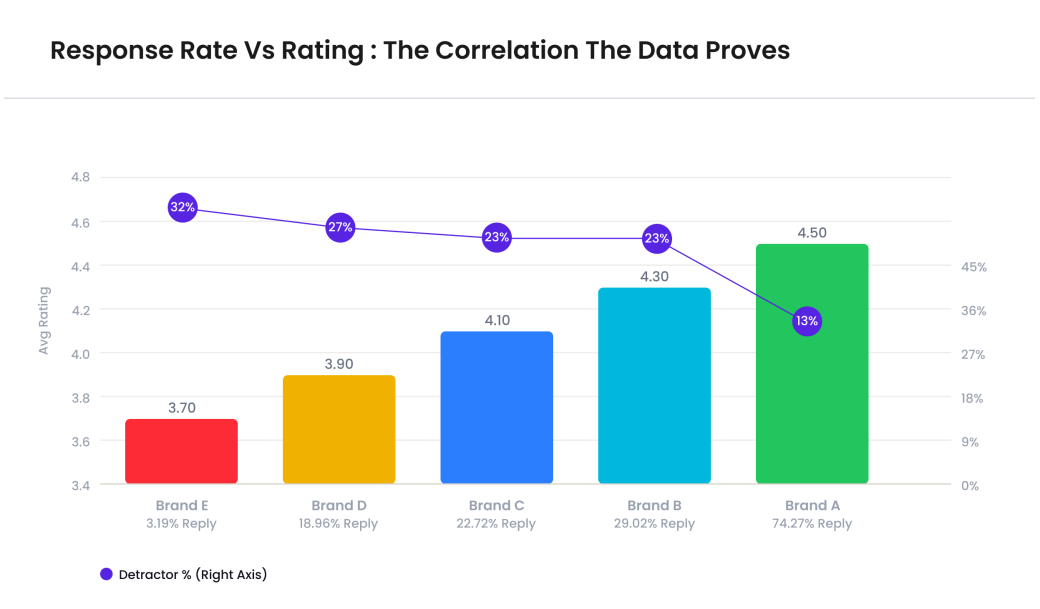

Brand E recorded the lowest response rate at 3.19% and the lowest average rating of 3.70. The highest detractor percentage of 32% indicates poor customer engagement significantly affects overall customer satisfaction. Moreover, Brand D achieved an 18.96% response rate with an average rating of 3.90. Detractor sentiment reduced to 27%, suggesting moderate customer engagement contributes positively toward improving consumer perception and ratings.
Active response management also creates opportunities for customer recovery because public engagement demonstrates operational attentiveness and commitment to service improvement. Brand C maintained a 22.72% response rate and achieved a 4.10 average rating. Stable engagement levels helped reduce detractor sentiment to 23%, demonstrating stronger operational responsiveness and customer trust. However, Brand B recorded a 29.02% response rate alongside a strong 4.30 average rating. Lower detractor levels of 23% highlight how active review management supports stronger customer satisfaction outcomes. Businesses failing to engage with customer concerns often appear disconnected from consumer expectations. Moreover, Brand A achieved the highest response rate at 74.27% and the highest average rating of 4.50. The lowest detractor percentage of 13% demonstrates the strong relationship between engagement and reputation.
6.2 Google Rewards Active Customer Engagement
Google increasingly prioritises businesses maintaining active customer engagement signals. Review responses indicate profile activity, operational attentiveness, and customer interaction quality, all of which contribute positively to local ranking performance.
Businesses actively responding to reviews often benefit from improved customer trust, stronger digital credibility, and better local SEO performance. This demonstrates that reputation management is no longer only a customer service responsibility; it has become a strategic SEO and growth function.
6.3 AI and Automation Are Changing Reputation Management
As review ecosystems continue expanding, many QSR businesses now require advanced systems capable of monitoring customer sentiment at scale. Artificial intelligence increasingly supports reputation management through sentiment analysis, competitor benchmarking, review categorisation, ranking fluctuation tracking, and automated engagement workflows.
AI-powered systems help businesses identify operational weaknesses proactively before reputation problems escalate publicly. This transformation will likely become essential for multi-location restaurant brands operating within highly competitive digital environments.
7.0 The Future of India’s QSR Industry Will Be Digitally Driven
7.1 Reputation Management Will Become Operational Infrastructure
The future QSR industry will increasingly treat reputation management as operational infrastructure rather than a secondary marketing activity. Businesses will require systems capable of monitoring reviews in real time, tracking customer sentiment, benchmarking competitors, and identifying operational complaint patterns proactively.
7.2 Customer Experience Will Influence Search Visibility
As Google increasingly prioritises customer engagement quality and operational reputation, customer experience itself will continue influencing local search visibility directly. Businesses delivering reliable service quality consistently will likely dominate future local discovery ecosystems.
7.3 AI-Powered Reputation Intelligence Will Expand
Artificial intelligence will play a major role in the future of restaurant reputation management. AI-powered systems can rapidly analyse customer sentiment, detect operational issues early, benchmark competitors, improve engagement workflows, and monitor ranking fluctuations across cities.
This transformation will become increasingly essential for multi-location restaurant brands competing within India’s digital-first food ecosystem.
8.0 Conclusion
8.1 India’s QSR Industry Is Becoming Search-Driven
India’s QSR industry is rapidly transitioning toward a search-driven and reputation-focused competitive environment where Google reviews, local SEO visibility, customer engagement, and operational consistency significantly influence business performance.
Businesses can no longer depend only on physical scale or advertising dominance to maintain market leadership.
8.2 Customer Sentiment Is Becoming a Growth Metric
The analysis clearly demonstrates that customer sentiment increasingly affects local visibility, ranking stability, customer trust, purchasing decisions, and long-term brand perception.
This means reputation management is becoming one of the most important operational growth strategies within the restaurant industry.
8.3 The Future of QSR Growth Will Depend on Reputation Intelligence
As review ecosystems continue expanding, businesses will increasingly require advanced reputation intelligence systems capable of monitoring customer sentiment, benchmarking competitors, tracking rankings, and identifying operational weaknesses proactively. Platforms such as RightChoice.AI are helping businesses transform customer feedback into actionable intelligence through multi-location review monitoring, sentiment analysis, local ranking tracking, competitor benchmarking, and reputation performance management. For modern QSR brands operating within India’s increasingly digital restaurant ecosystem, reputation management is no longer optional it is becoming one of the strongest drivers of visibility, trust, and long-term growth.