



1. Introduction: The New Coffee War Starts on Google, Not at the Counter
Do you know where India’s coffee chains are actually competing today?
Well! It isn’t inside malls, high streets, or premium retail locations. The real battle begins on Google, long before a customer walks through the door.
Consumers are increasingly discovering their next coffee stop through searches such as “coffee near me,” “best café near me,” and “coffee shop open now.” In those few seconds, purchase decisions are shaped not by menu design or store interiors, but by Google Reviews, star ratings, customer photos, and the visibility of a café’s Google Business Profile on Google Maps.
75% of local searches result in a purchase within 24 hours, highlighting how quickly local intent converts into revenue for cafés and restaurant. For modern coffee chains in India, a well-optimised Google Business Profile for cafés is no longer just a listing, it is a growth engine that drives visibility, footfall, and revenue.
To understand who is winning this digital coffee war, we tracked seven major coffee chains across India for twelve months and analysed the review signals behind their success.
2. More Reviews Does Not Mean More Customers
2.1 The Biggest Myth in Local Search
Ask most café operators what defines success on Google Reviews, and the answer is usually the same: more reviews.
The assumption feels logical. More reviews should create more trust, better Google Maps rankings, stronger local SEO performance, and ultimately more customers walking through the door.
But Google’s local algorithm has become significantly more sophisticated than that.
When determining which businesses deserve visibility, Google increasingly looks beyond volume and focuses on the overall quality and usefulness of customer feedback.
2.2 What Google Actually Looks For
A strong Google Business Profile is built on multiple trust signals working together rather than a single metric.
Google increasingly rewards businesses that demonstrate:
- Recent and consistent review activity
- Positive customer sentiment
- Strong average ratings
- Active responses to customer feedback
- Relevant keywords appearing naturally in reviews
- High customer engagement on Google Maps
- In other words, Google is trying to identify businesses that customers genuinely trust and recommend, not simply businesses that have existed the longest.
2.3 Review Quality Is Becoming the Real Competitive Advantage
The better question for businesses is no longer:
“How many reviews do we have?”
Instead, it is:
“Are our reviews recent, positive, relevant, and helping us rank for high-intent searches such as coffee near me, best café near me, and coffee shop open now?”
Because in today’s world of Google Business Profile optimisation, Google Maps SEO, and local search visibility, review quality consistently outperforms review quantity.
3. Why Review Responses Are Becoming a Competitive Advantage for Coffee Chains
3.1 Coffee Customers Expect Conversations, Not Silence
Coffee is one of the most experience-driven categories in the food and beverage industry. Customers do not simply buy a cappuccino or cold brew; they buy ambience, service, speed, convenience, and consistency.
As a result, reviews for coffee chains in India often go beyond the product itself. Customers discuss barista friendliness, waiting times, seating availability, music, cleanliness, Wi-Fi quality, and delivery experiences. When those reviews remain unanswered, customers can interpret silence as indifference.
3.2 The Difference Between Coffee Brands Is No Longer Coffee Alone
One of the clearest differences between leading and lagging coffee chains is not menu innovation or store design, it is customer engagement.
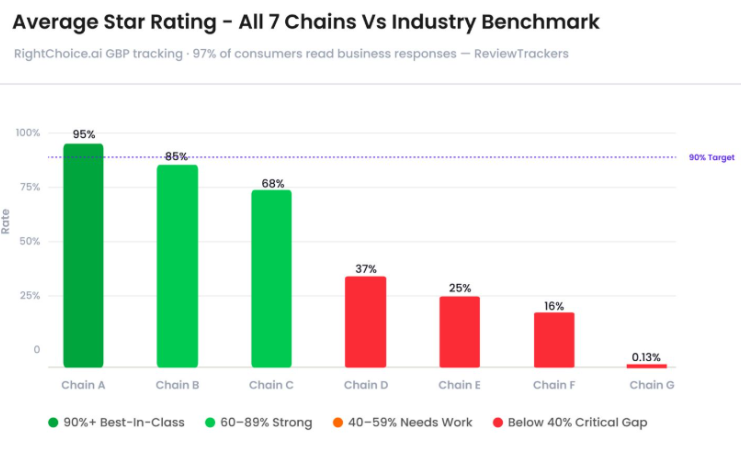

Brand A (95%) and Brand B (86%) demonstrate that high review response rates are achievable at scale and likely contribute to stronger customer trust and local visibility. Brand C (68%) remains competitive but has room for improvement. Meanwhile, Brands D, E, F, and G face a growing engagement deficit that could weaken Google Maps rankings, reduce click-through rates, and limit footfall growth over time.
In a market where customers can compare multiple cafés on Google Maps within seconds, these differences become highly visible.
3.3 Every Unanswered Review Is a Missed Customer Recovery Opportunity
Imagine a customer leaving a one-star review because their order took too long during the morning rush or because a delivery arrived late and cold.
If the review receives no response, future customers only see the complaint. If the café acknowledges the issue, apologises, and offers a solution, future customers see accountability. For coffee chains competing location by location, that difference can directly influence store visits and customer trust.
3.4 Higher Ratings Create More Clicks and More Footfall
In local search, small differences in ratings can create large differences in performance.
A Brand A maintaining an average rating of 4.5 stars can attract up to 25% more clicks than one operating closer to 4.3 stars. Reviews also contribute to stronger conversion rates and increased revenue, making customer experience improvements commercially valuable rather than simply reputationally valuable. 78% of consumers will not consider a business with a rating below 4 stars, making star ratings one of the strongest determinants of footfall and conversion.
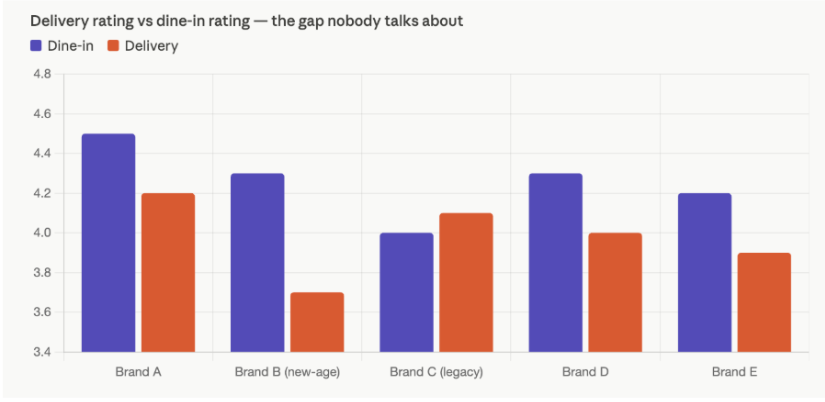

For customers searching “best coffee near me”, star ratings often become the deciding factor between two otherwise similar options.
4. The Google 3-Pack Is Becoming the Most Valuable Corner in the Coffee Business
4.1 The Best Café Location May No Longer Be on the High Street
For decades, coffee chains fought for premium retail locations near offices, shopping centres, universities, and transport hubs. The assumption was simple: better location meant more footfall.
Today, the most valuable location for a coffee brand may not be a street corner at all, it may be the first position on Google Maps.
When customers search for “coffee near me”, “best café near me”, or “coffee shop open now”, they are usually ready to make an immediate decision. The café that appears first often becomes the café that gets visited.
4.2 Why the Google Local Pack Matters So Much for Coffee Chains
The Google Local Pack, often called the Google 3-Pack, has become the digital equivalent of the busiest retail intersection in the city. Research shows that the Local Pack appears in 93% of local-intent searches, while the first position captures between 23% and 28% of all clicks. For coffee brands competing outlet by outlet across multiple cities, these rankings directly influence discovery, footfall, and revenue. A customer choosing between three nearby cafés will often select from the businesses Google shows first rather than continue searching further down the page.
4.3 Coffee Discovery Has Become a Mobile Behaviour
Unlike many retail purchases, coffee decisions are often spontaneous and immediate. Customers search while commuting to work, leaving meetings, shopping with friends, or looking for a place to work remotely for a few hours. This makes mobile search visibility especially important for café brands. 62% of consumers avoid businesses with inaccurate online information, meaning incorrect opening hours, addresses, or phone numbers can directly reduce visits and revenue, making Google Business Profile optimisation one of the most important investments for multi-location operators.
4.4 Why Follower Count Matters Less Than Local Visibility
Many café brands invest heavily in social media campaigns and influencer collaborations. While these activities can support brand awareness, they rarely influence customers at the exact moment they are deciding where to buy coffee.
A customer searching for “best coffee near me” is not comparing Instagram follower counts. They are comparing star ratings, review quality, photos, distance, and convenience.
The coffee brands winning local search are increasingly winning these moments of intent.
5. The Monthly Trends That Annual Reports Never Show
5.1 The Problem With Looking Only at Annual Numbers
Most coffee chains evaluate performance using quarterly reviews, annual reports, and year-end summaries. While these numbers are useful for measuring overall growth, they often hide the smaller shifts that determine whether a brand is gaining or losing momentum in local markets.
For coffee chains in India, customer behaviour changes quickly. A successful seasonal menu launch, a store renovation, faster service times, or improved customer engagement can influence reviews and Google Maps rankings within weeks rather than months.
By the time these changes become visible in annual reports, the opportunity may already have passed.
5.2 Coffee Demand Moves Faster Than Most Businesses Think
Unlike many retail purchases, coffee consumption is highly frequent and habit-driven. Customers may visit the same café several times a week, meaning their experiences generate a constant stream of feedback and fresh signals for Google’s local algorithm.
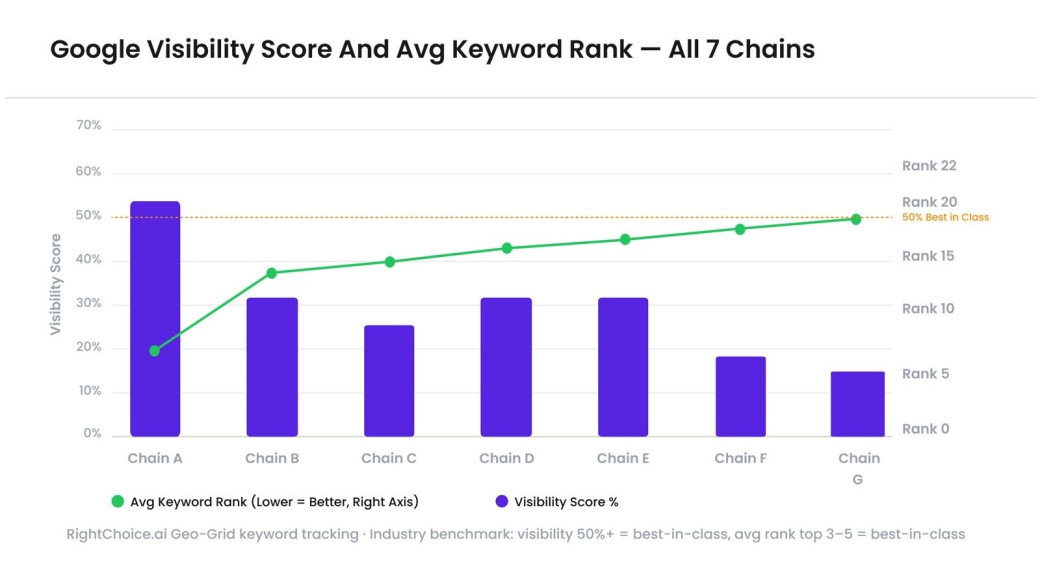

The findings reinforce that visibility and rankings do not always move together. Brand A combines a best-in-class visibility score above 50% with a strong average keyword position, making it the category leader in local discovery. In contrast, Brands F and G achieve relatively strong keyword rankings but struggle with visibility depth, suggesting limited market coverage across city geographies. For coffee chains, success depends not only on ranking highly for a few keywords but on maintaining broad local search visibility and share of voice across the entire city.
This makes review velocity particularly important for coffee brands. Consistent customer feedback tells Google that a location remains active, relevant, and popular within its market.
Businesses relying solely on historical reputation often struggle to maintain visibility against competitors generating stronger review momentum.
5.3 The Monthly Dashboard Every Coffee Brand Should Be Watching
Annual averages are useful for board presentations.
Monthly trends are useful for decisions.
For modern coffee chains, an effective Google Business Profile dashboard should monitor:
- Review velocity
- Review response rate
- Average star ratings
- Google Local Pack visibility
- Keyword rankings
- Customer sentiment trends
- Share of Voice
- Delivery versus dine-in experiences
These indicators provide early warnings of operational problems and early signs of competitive advantage.
6. More Stores Do Not Always Mean More Customers
6.1 The Traditional Measure of Success in Coffee Was Scale
For years, growth in the coffee industry was measured by one simple number: outlet count. More stores meant greater visibility, stronger market presence, and easier access for customers.
While physical expansion remains important, the rise of Google Maps, Google Reviews, and local SEO has changed how customers discover coffee brands. Today, digital visibility often influences customer choice before store location ever gets a chance to.
A coffee chain may operate dozens of outlets in a city, but if customers cannot find those outlets online, the advantage of scale quickly disappears.
6.2 Why Share of Voice Matters More Than Outlet Count
In local search, Share of Voice measures how often a brand appears when customers search for terms such as “coffee near me”, “best café near me”, or “coffee shop open now”.
This metric is becoming increasingly important because it reflects digital market share rather than physical market share.
A brand with fewer locations but stronger Google Maps visibility can often outperform a competitor with significantly more outlets but weaker search presence.
The businesses winning customer attention are not always the businesses with the most stores, they are the businesses appearing most frequently at moments of intent.
6.3 A City With 5 Great Listings Can Outperform 30 Average Ones
Consider two hypothetical cities.
The first contains 30 coffee outlets, but many suffer from weak Google Business Profile optimisation, inconsistent reviews, and poor visibility in local search results.
The second contains only five outlets, but each location maintains strong ratings, active review responses, and excellent Google Maps rankings.
From a digital perspective, the second city may actually outperform the first despite having a much smaller physical footprint.
Interestingly, both cities still pay similar costs for rent, staff, and operations.
6.4 Geo-Grid Analysis Is Changing How Coffee Brands Measure Markets
Modern local SEO tools increasingly use Geo-Grid analysis to understand how visible each outlet is across different parts of a city.
Instead of measuring a single ranking position, brands can now identify:
- Areas of strong visibility
- Areas where competitors dominate
- Locations with declining performance
- Opportunities for review generation and optimisation
For multi-location coffee chains, this provides a far more accurate picture of market strength than outlet numbers alone.
6.5 Digital Market Share Is Becoming Physical Market Share
As customer journeys continue moving online, digital visibility increasingly determines offline performance.
The coffee chains dominating Google Maps, maintaining stronger review velocity, and building greater local search visibility are often the same brands attracting more footfall and stronger customer loyalty.
The old rule of retail expansion was simple: open more stores.
The new rule may be even simpler:
Be easier to find than your competitors.
7. What Customers Write Is What Google Understands
7.1 Reviews Are No Longer Just Feedback
For coffee chains, customer reviews are often treated as customer satisfaction indicators. For Google, they are something much bigger: data points that help define what each outlet is known for.
Every review contributes to Google’s understanding of whether a location is associated with great coffee, fast service, comfortable workspaces, or long waiting times. In many ways, customers are helping Google’s algorithm decide which cafés deserve visibility.
7.2 Coffee Customers Tell Google What Your Brand Stands For
Unlike star ratings, review text provides context. When customers repeatedly mention phrases such as great coffee, good ambience, friendly staff, comfortable seating, or good place to work, Google begins associating those attributes with the location.
Similarly, repeated mentions of poor service or delays can influence how the business is perceived digitally.
For coffee chains in India, reviews increasingly function as an extension of brand positioning.
7.3 The Themes Customers Reward Most
Across the coffee category, positive reviews consistently focused on:
- Coffee quality
- Ambience and interiors
- Staff friendliness
- Service quality
- Seating comfort
- Workspace suitability
These themes influence not only customer decisions but also the relevance signals supporting stronger Google Maps rankings.
7.4 The Problems Customers Mention Most Often
Negative reviews showed a different pattern.
Recurring issues frequently included:
- Order delays
- Long waiting times
- Billing errors
- Customer handling issues
- Delivery delays
- Value-for-money concerns
Importantly, these operational issues eventually become visibility issues once they begin appearing repeatedly in public reviews.
7.5 Ratings Alone Never Tell the Full Story
Approximately 94% of diners use online resources before discovering new restaurants and cafés.
As a result, customers increasingly read recent reviews rather than relying solely on overall ratings.
A café operating at 4.2 stars may still struggle with persistent complaints around waiting times, while a 4.5-star location may suffer from delivery issues hidden beneath an otherwise strong score.
This is why sentiment analysis is becoming just as important as ratings analysis.
8. Reviews Are No Longer Social Proof. They Are a Ranking Mechanism.
8.1 The Thresholds That Separate Winners From Everyone Else
Across the category, brands maintaining review response rates above 60% and generating at least three new reviews per location per day generally maintained or improved their local rankings.
Businesses operating below these thresholds were more likely to experience gradual ranking decline over time.
The relationship between reviews and visibility is no longer theoretical.
It is operational.
8.2 Ranking Loss Happens Slowly, Then Suddenly
One of the biggest dangers in local SEO is that performance rarely collapses overnight.
Instead, competitors slowly accumulate stronger review momentum, better engagement, and greater local authority until rankings begin to shift.
Once local visibility is lost, recovery often requires 12 to 18 months of sustained effort.
Preventing decline is therefore significantly cheaper than rebuilding authority later.
9. Advanced Local SEO Strategies Using RightChoice.AI
9.1 Build Review Velocity, Not Just Review Volume
Why it matters
Google rewards businesses that consistently generate fresh reviews. For coffee chains, regular customer feedback signals relevance and activity, helping improve Google Maps rankings and local search visibility.
How to implement
- Add review QR codes to tables, bills, takeaway cups, and receipts.
- Encourage baristas to request reviews after positive experiences.
- Set monthly review targets for each outlet.
- Run review campaigns after product launches or store openings.
- Monitor review generation weekly at store level.
How RightChoice.AI enables it
RightChoice.AI transforms review collection from a reactive process into a measurable growth system. Through Manage Multiple Listings, brands can monitor review generation across every outlet from a single dashboard rather than reviewing stores individually. AI Review Auto Reply and the Review Reply Generator ensure that increasing review volumes do not create operational bottlenecks by automating customer engagement at scale.
9.2 Turn Review Responses Into Customer Recovery
Why it matters
For coffee businesses, negative reviews often revolve around waiting times, incorrect orders, seating availability, delivery issues, or staff interactions. Every unanswered complaint represents not only a lost customer but also a lost opportunity to reassure hundreds of future customers reading that review.
How coffee chains can implement it
- Create response ownership structures at regional and outlet level.
- Define escalation procedures for operational complaints.
- Establish mandatory response targets for one-star and two-star reviews.
- Train managers on review handling and customer recovery techniques.
- Use templates for common scenarios while maintaining personalisation.
- Conduct weekly reviews of unresolved complaints.
How RightChoice.AI enables it
RightChoice.AI automates much of the manual effort traditionally associated with review management. The platform’s AI Sentiment Analysis identifies high-priority complaints that require immediate intervention, while the Review Reply Generator helps store teams respond faster and more consistently.
9.3 Win More Google Local Pack Rankings
Why it matters
The first three businesses appearing on Google Maps capture a disproportionate share of customer attention and footfall. For coffee chains, appearing in the Google Local Pack often matters more than social media reach or brand awareness campaigns.
How coffee chains can implement it
- Maintain complete and accurate Google Business Profiles for every location.
- Standardise categories, descriptions, and attributes across outlets.
- Upload fresh product photography and menu images regularly.
- Publish weekly updates and local offers through Google Posts.
- Optimise business descriptions for location-specific search terms.
- Track keyword rankings city by city rather than nationally.
How RightChoice.AI enables it
RightChoice.AI provides coffee brands with enterprise-level visibility tracking capabilities. The Local Keywords Ranker identifies the search terms customers actually use in each market, while the Geo Grid Tracker measures visibility across neighbourhoods rather than relying on a single ranking position. The Local Post Scheduler further supports profile activity by helping brands maintain regular updates across hundreds of locations simultaneously.
9.4 Monitor Sentiment Before Ratings Decline
Why it matters
By the time a star rating falls significantly, the underlying operational problems have often existed for months. Waiting times, inconsistent coffee quality, delivery problems, and customer service issues typically appear in review text long before they impact overall ratings.
How coffee chains can implement it
- Categorise customer feedback into themes such as service, product quality, delivery, ambience, and pricing.
- Track complaint trends monthly rather than annually.
- Separate dine-in sentiment from delivery sentiment.
- Share location-specific feedback with store managers.
- Use review themes to guide staff training programmes.
How RightChoice.AI enables it
RightChoice.AI’s AI Sentiment Analysis automatically categorises customer feedback and identifies recurring themes across locations. Instead of manually reading thousands of reviews, businesses can quickly understand whether complaints relate to speed, service, coffee quality, or delivery. This allows operators to address issues proactively rather than reacting after ratings have already declined.
9.5 Measure Share of Voice Instead of Store Count
Why it matters
A coffee chain with thirty outlets but poor search visibility may underperform a competitor with only five highly visible stores. Digital market share increasingly determines physical market share.
How coffee chains can implement it
- Measure visibility at city level rather than brand level.
- Track local rankings across all important keywords.
- Benchmark competitor visibility monthly.
- Build review density early in Tier-2 cities.
- Monitor changes in local share of voice over time.
- Identify neighbourhoods where competitors dominate.
How RightChoice.AI enables it
RightChoice.AI replaces assumptions with visibility data. The Competitor Tracker allows businesses to benchmark local performance against rival coffee brands, while the Geo Grid Tracker visualises visibility across entire cities. The Customer Heat Map highlights areas where additional investment may generate the greatest return, and 20+ Directory Integrations ensure brand consistency across multiple search ecosystems. Combined with Manage Multiple Listings, these tools provide a complete view of digital market share across all locations.
10. The Brands Winning Local Search Will Win India’s Coffee Market
10.1 Google Reviews Are Becoming Growth Infrastructure
For modern coffee chains in India, Google Reviews have evolved far beyond reputation management.
They now influence:
- Google Maps rankings
- Customer trust
- Click-through rates
- Footfall
- Conversion rates
- Revenue growth
Reviews have become infrastructure rather than marketing assets.
10.2 The Winners Are Solving Operational Problems
The brands winning local search are rarely the businesses with the biggest advertising budgets.
Increasingly, they are the businesses with:
- Higher response rates
- Faster complaint resolution
- Better review momentum
- Stronger operational ownership
- More effective Google Business Profile optimisation
These are operational advantages rather than marketing advantages.
10.3 The Future of Coffee Growth Is Hyperlocal
As India’s coffee café market continues to expand, competition will increasingly happen location by location rather than brand by brand. For coffee brands, this means treating Google Reviews, Google Business Profile management, and local SEO as core business infrastructure rather than marketing activities.
By bringing key business tools, local search into a single platform, RightChoice.AI enables coffee chains to identify opportunities faster, respond to customer feedback more effectively, and improve local visibility across every outlet. The advantage no longer belongs to the brands collecting the most data. It belongs to the brands turning that data into action fastest.