Introduction: Why Are SEO Keywords the Foundation of Every Successful SEO Strategy?
Have you ever wondered why some websites consistently appear on Google’s first page while others struggle to attract organic traffic despite publishing quality content? The answer lies in choosing the right SEO Keywords. Keywords help search engines understand your content and connect it with users actively searching for relevant information, products, or services. However, modern SEO is no longer about targeting a single keyword, it is about understanding search intent and using different keyword types strategically throughout the customer journey.
Google itself explains that its Search ranking systems evaluate hundreds of signals to deliver the most relevant and helpful results, making content relevance and keyword alignment essential for strong visibility.
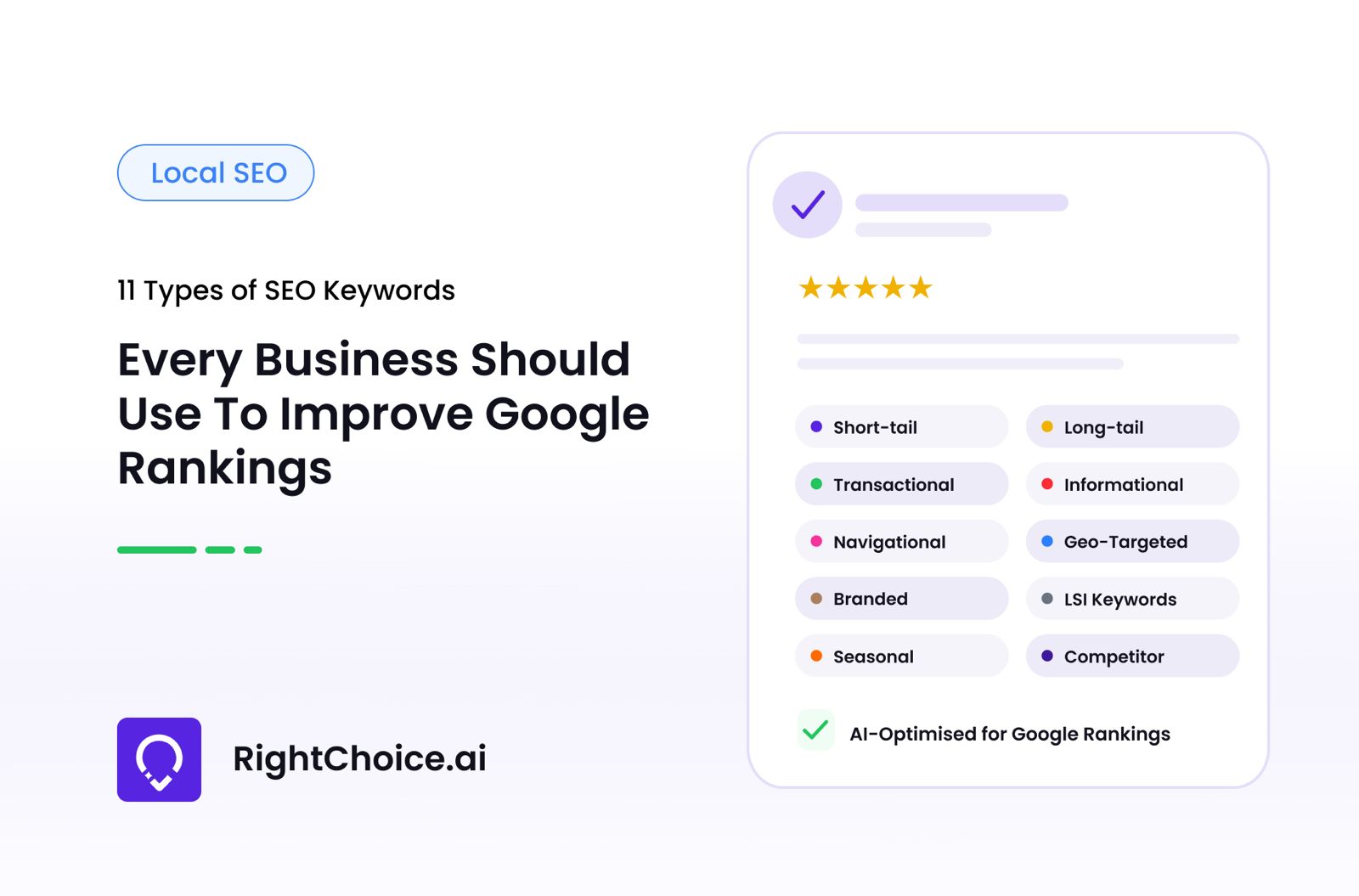
From short-tail keywords that increase visibility to long-tail, transactional, geo-targeted, and informational keywords that attract highly qualified users, each keyword type serves a distinct purpose within an effective SEO strategy. When combined strategically, these keywords help businesses improve Google rankings, increase organic traffic, strengthen Local SEO, and drive higher-quality leads.
In this guide, we will explore the 11 essential types of SEO Keywords, explain when and how to use each one, and demonstrate how RightChoice.AI helps businesses leverage AI-powered keyword research and optimisation to build sustainable search visibility, attract the right audience, and achieve long-term digital growth.
What Are SEO Keywords?
Definition of SEO Keywords
SEO Keywords are the words and phrases that users enter into search engines like Google to find information, products, services, or solutions online. They act as the bridge between user search queries and website content, helping search engines understand what a page is about. By strategically incorporating relevant SEO Keywords into webpages, blogs, and landing pages, businesses can improve Google rankings, attract targeted audiences, and increase organic traffic.
Why Search Engines Use Keywords
Search engines use SEO Keywords to understand the intent behind a user’s search and match it with the most relevant, accurate, and valuable content. Google’s algorithms evaluate keywords alongside factors such as content quality, relevance, user experience, and search intent to deliver the best possible results. Using the right keyword optimization strategy helps search engines index content correctly while improving visibility for relevant searches and strengthening Local SEO performance.
Why Different Types of SEO Keywords Matter
Matching User Search Intent
Every online search has a specific purpose, known as search intent. Some users seek information, while others compare products or are ready to make a purchase. Using different SEO Keywords, such as informational keywords, buyer intent keywords, and transactional keywords, allows businesses to create content that aligns with these varying intentions. Matching keywords with user intent improves content relevance, enhances user experience, and increases the likelihood of achieving higher Google rankings.
Supporting the Customer Journey
Short-tail keywords help build awareness, long-tail keywords address specific needs, while transactional and geo-targeted keywords encourage conversions. Incorporating multiple types of SEO Keywords ensures businesses remain visible at every stage of the customer journey, attracting qualified visitors and nurturing them into loyal customers.
Improving Rankings and Conversions
A well-balanced keyword strategy improves both search visibility and business performance. Combining SEO Keywords with strong content helps search engines understand website relevance while attracting highly targeted audiences. By using a mix of branded keywords, non-branded keywords, LSI keywords, and Local SEO terms, businesses can increase organic traffic, improve Google rankings, reduce bounce rates, and achieve higher conversion rates by reaching users with stronger purchase intent.
The 11 Types of SEO Keywords
Different SEO Keywords serve different purposes throughout the customer journey. While some keywords increase brand awareness, others help businesses attract users who are actively comparing solutions or ready to make a purchase. Understanding and using the right types of SEO Keywords enables businesses to improve Google rankings, increase organic traffic, strengthen Local SEO, and maximise conversions.
1. Short-Tail Keywords
Short-tail keywords are broad search terms consisting of one or two words that receive high search volumes. These SEO Keywords target general topics and help businesses reach a wider audience, although they are usually highly competitive. Examples include “Local SEO,” “Restaurant,” “Dentist,” “Hotel,” and “Google Business Profile.”
Benefits
- Short-tail keywords increase brand visibility by helping businesses appear for broad, high-volume searches.
- They generate substantial organic traffic, introducing potential customers to a business during the awareness stage.
- They strengthen website authority when supported by high-quality content and a comprehensive SEO strategy.
Example: A restaurant chain may target the keyword “Local SEO” to attract businesses looking for ways to improve their online visibility. Using RightChoice.AI’s Local Keyword Rank Tracker, businesses can identify high-volume short-tail keywords, monitor keyword rankings across multiple locations, and optimise their Google Business Profiles to improve local search performance.
2. Long-Tail Keywords
Long-tail keywords are highly specific search phrases containing three or more words that target users with clear search intent. Although these SEO Keywords have lower search volumes than broad keywords, they attract highly relevant visitors who are actively looking for a particular product, service, or solution. Examples include “best local SEO software for restaurants”, “Google Business Profile optimisation for hotels,” and “AI keyword tracker for multiple locations.”
Benefits
- Long-tail keywords attract highly qualified users who are closer to making a purchasing decision.
- They are less competitive, making it easier for businesses to achieve higher Google rankings.
- They improve conversion rates by addressing specific customer needs and search queries.
Example: A hotel group may optimise its content for “Google Business Profile optimisation for hotels” instead of simply targeting “SEO.” RightChoice.AI helps businesses identify high-performing long-tail keywords, analyse their ranking potential, and generate AI-optimised local content that improves visibility across Google Search and Maps.
3. Branded Keywords
Branded keywords include the name of a company, product, or platform within a search query. These SEO Keywords are typically used by customers who are already familiar with a brand and are searching for specific information, services, or support. Examples include “RightChoice.AI,” “Google Business Profile,” or “RightChoice.AI Keyword Rank Tracker.”
Benefits
- Branded keywords strengthen customer trust by directing users to official business websites and verified resources.
- They improve click-through rates because users searching for a specific brand generally demonstrate stronger engagement intent.
- They help businesses protect their online visibility by ensuring official pages rank above third-party websites or competitors.
Example: A business searching for “RightChoice.AI Geo Grid Rank Tracker” or “RightChoice.AI Review Management” is already interested in the platform’s capabilities. RightChoice.AI enables businesses to optimise branded pages, monitor branded keyword performance, and improve visibility for branded searches while providing comprehensive analytics across multiple locations.
4. Non-Branded Keywords
Non-branded keywords describe products or services without mentioning a specific company or platform. These SEO Keywords help businesses attract users who are researching solutions but have not yet selected a provider. Examples include “local keyword rank tracker,” “review management software,” “Google Business Profile management,” and “AI local SEO platform.”
Benefits
- Non-branded keywords help businesses attract new audiences who are actively searching for relevant solutions.
- They increase organic traffic by targeting users before they develop loyalty towards a particular brand.
- They improve search visibility by enabling businesses to compete across broader industry-related search queries.
Example: A retailer searching for “review management software for multiple locations” or “AI local SEO platform” is comparing available solutions. RightChoice.AI helps businesses rank for these high-value non-branded keywords through AI-powered keyword tracking, competitor analysis, content generation, Google Business Profile optimisation, and local SEO recommendations, increasing visibility among customers who are evaluating different platforms.
5. Buyer Intent Keywords
Buyer intent keywords, also known as commercial intent keywords, are search terms used by customers who are actively comparing products or services before making a purchase decision. These SEO Keywords indicate that users have moved beyond the awareness stage and are evaluating the best solution for their needs. Examples include “best local SEO software,” “top Google Business Profile management platform,” and “AI-powered keyword rank tracker.”
Benefits
- Buyer intent keywords help businesses attract highly qualified leads who are close to making a purchasing decision.
- They improve conversion opportunities by connecting businesses with users actively comparing different solutions.
- They increase marketing efficiency by targeting customers with strong commercial intent instead of general information seekers.
Example: A multi-location retail business searching for “best Google Business Profile management software” or “AI-powered local SEO platform” is actively evaluating available solutions before investing. RightChoice.AI helps businesses identify high-converting buyer intent keywords, analyse competitor offerings, and optimise service pages that increase enquiries, demo requests, and customer conversions.
6. Informational Keywords
Informational keywords are search queries used by people looking for knowledge, guidance, or answers to specific questions. These SEO Keywords typically begin with phrases such as “what is,” “how to,” “why,” or “benefits of.” Examples include “What is Local SEO?”, “How to optimise a Google Business Profile?”, and “Benefits of AI keyword tracking.”
Benefits
- Informational keywords help businesses educate their audience while establishing industry expertise and credibility.
- They attract users during the awareness stage, increasing organic traffic through valuable educational content.
- They build long-term trust by positioning businesses as authoritative sources of information within their industry.
Example: A franchise owner searching “How to improve Google Business Profile rankings?” is looking for practical guidance rather than a product. By creating informative blogs around such queries, businesses can attract relevant traffic and nurture potential customers. RightChoice.AI helps businesses discover high-value informational keywords and create AI-optimised content that educates users while naturally guiding them toward relevant products and services.
7. Navigational Keywords
Navigational keywords are search terms used by customers who already know the name of a business, platform, or website and want to access a specific page. Instead of typing the website address directly, users search for the business or feature they need. Examples include “RightChoice.AI Login,” “RightChoice.AI Geo Grid Rank Tracker,” or “Google Business Profile Help.”
Benefits
- Navigational keywords help users quickly locate the correct website, product page, or support resource.
- They strengthen brand visibility by ensuring official webpages appear prominently in search results.
- They improve customer experience by making important resources easy to find and access.
Example: A customer searching for “RightChoice.AI Geo Grid Rank Tracker” or “RightChoice.AI Dashboard” already intends to use the platform and needs quick access to a specific feature. RightChoice.AI helps businesses optimise branded webpages, improve website architecture, and strengthen internal linking so customers can easily navigate to the information or tools they require.
8. Transactional Keywords
Transactional keywords are search terms used by customers who are ready to complete an action, such as purchasing a product, requesting a demo, booking a consultation, or starting a free trial. These SEO Keywords demonstrate the highest purchase intent and often include words like “buy,” “book,” “request demo,” “pricing,” or “free trial.”
Benefits
- Transactional keywords attract users who are ready to take immediate action, resulting in higher conversion rates.
- They improve lead generation by directing qualified visitors to product pages, demo requests, or contact forms.
- They maximise marketing return on investment by focusing on customers with the strongest purchase intent.
Example: A business searching for “Book Google Business Profile demo” or “Local SEO software pricing” has already decided to explore a solution and is looking for the final information before making a purchase. RightChoice.AI helps businesses optimise high-converting landing pages, identify transactional keywords with strong commercial value, and implement AI-driven recommendations that increase enquiries, demo bookings, and customer acquisitions.
9. Geo-Targeted Keywords
Geo-targeted keywords are SEO Keywords that include a specific geographic location, such as a city, state, region, or country. These keywords help businesses reach customers searching for products or services within a particular area, making them essential for Local SEO and multi-location businesses. Examples include “best coffee shop in New York,” “dentist in Dubai,” “SEO agency in London,” and “Google Business Profile optimisation in Singapore.”
Benefits
- Geo-targeted keywords improve Local SEO by helping businesses rank higher in location-specific Google Search and Google Maps results.
- They attract highly relevant local customers who are actively searching for nearby products or services with strong purchase intent.
- They increase enquiries, store visits, and local conversions by targeting users based on their geographical location.
Example: A restaurant chain with branches across multiple cities may optimise individual location pages for keywords such as “Italian restaurant in Manchester” or “family restaurant in Birmingham.” Instead of using the same keyword strategy for every branch, RightChoice.AI enables businesses to track location-specific keyword rankings using its Geo-Grid Rank Tracker, optimise each Google Business Profile, and identify local keyword opportunities that improve visibility across every business location.
10. LSI (Semantic) Keywords
LSI (Latent Semantic Indexing) keywords, commonly referred to as semantic keywords, are words and phrases that are contextually related to a primary keyword. Rather than repeating the same keyword multiple times, these SEO Keywords help search engines understand the overall topic and context of a webpage. For example, semantic keywords related to “Local SEO” may include “Google Business Profile,” “local search rankings,” “business listings,” “customer reviews,” and “Google Maps optimisation.”
Benefits
- LSI keywords improve content relevance by providing contextual signals that help search engines better understand webpage topics.
- They create more natural and engaging content by reducing unnecessary keyword repetition and improving readability.
- They increase opportunities to rank for multiple related search queries, strengthening topical authority and overall SEO performance.
Example: A business writing a blog about Local SEO should naturally include related terms such as Google Business Profile, business listings, local search rankings, customer reviews, and location pages throughout the content. RightChoice.AI simplifies this process by providing AI-powered content recommendations and semantic keyword suggestions that help businesses create comprehensive, search-friendly content aligned with Google’s evolving search algorithms.
11. Competitor Keywords
Competitor keywords are search terms that competing businesses rank for or actively target within their SEO strategy. Analysing these SEO Keywords helps organisations understand competitor strengths, identify keyword gaps, and discover opportunities to improve their own search visibility. Examples include keywords such as “Google Business Profile management software,” “local keyword rank tracker,” or “AI review management platform,” depending on the competitive landscape.
Benefits
- Competitor keywords help businesses identify valuable keyword opportunities by analysing what drives traffic to competing websites.
- They reveal content and ranking gaps that can be targeted to improve Google rankings and increase organic traffic.
- They support smarter SEO decision-making by enabling businesses to develop more competitive, data-driven content strategies.
Example: A business looking to improve its Local SEO may discover that competitors rank highly for keywords such as “best Google Business Profile management software” or “local keyword rank tracker.” Using RightChoice.AI’s Competitor Tracking and AI-powered keyword analysis, businesses can identify these high-performing keywords, compare ranking performance across multiple locations, uncover missed opportunities, and optimise their content strategy to outperform competitors in local search results.
How to Build an Effective SEO Keyword Strategy
Understand Search Intent
An effective keyword strategy begins with understanding search intent, which reflects the purpose behind a user’s search query. Aligning SEO Keywords with informational, commercial, navigational, or transactional intent helps businesses create relevant content, improve user experience, and achieve stronger Google rankings.
Use a Balanced Keyword Mix
Relying on a single keyword type limits SEO performance. Businesses should combine short-tail keywords for broader visibility, long-tail keywords for niche targeting, informational keywords for educational content, transactional keywords for conversions, and geo-targeted keywords for Local SEO.
Monitor Keyword Performance
Keyword optimisation is an ongoing process that requires continuous monitoring. Businesses should regularly evaluate keyword rankings, search visibility, click-through rates, impressions, and conversion performance using SEO analytics tools. Tracking keyword performance helps identify emerging opportunities, measure campaign success, and refine the overall SEO strategy based on real search behaviour and customer engagement.
Continuously Optimise Content
Businesses should refresh existing webpages by incorporating new SEO Keywords, improving content quality, updating outdated information, and strengthening internal linking. Continuous optimisation ensures content remains relevant, improves Google rankings, supports semantic SEO, and maintains long-term organic traffic growth.
How RightChoice.AI Helps Businesses Optimise SEO Keywords
Developing an effective keyword strategy requires more than identifying high-volume search terms. Businesses must understand customer intent, monitor competitor performance, optimise content continuously, and adapt to changing search trends. Performing these activities manually can be time-consuming and inefficient, particularly in highly competitive markets. RightChoice.AI simplifies the entire SEO process through AI-powered insights, enabling businesses to discover valuable SEO Keywords, improve Google rankings, increase organic traffic, and build data-driven SEO strategies that deliver sustainable growth.
AI-Powered Keyword Research
RightChoice.AI uses advanced artificial intelligence to identify high-value SEO Keywords based on search volume, competition, user behaviour, and market trends. This enables businesses to discover profitable keyword opportunities that improve Google rankings and attract qualified organic traffic.
Competitor & Search Intent Analysis
The platform performs intelligent competitor analysis by identifying the keywords competitors rank for and highlighting untapped opportunities. It also analyses search intent, helping businesses create content that aligns with informational, commercial, navigational, and transactional searches for higher engagement and conversions.
Content & Local SEO Optimisation
RightChoice.AI provides AI-driven recommendations to optimise website content, blogs, landing pages, and metadata using relevant SEO Keywords and semantic terms. It also strengthens Local SEO by identifying location-specific keywords and optimising Google Business Profiles to improve visibility in local search results.
Performance Tracking & AI Recommendations
The platform continuously monitors keyword rankings, impressions, clicks, and conversion performance through real-time analytics. Using intelligent AI recommendations, businesses receive actionable insights to refine their keyword strategy, optimise underperforming content, and maintain long-term search visibility in an increasingly competitive digital landscape.
The Future of SEO Keywords in the AI Search Era
Search engine optimisation is evolving rapidly as artificial intelligence reshapes how users search for information and how search engines interpret content. Modern SEO is moving beyond traditional keyword matching towards understanding user intent, context, and content relevance. Artificial intelligence is changing how search engines understand content by focusing on context, user behaviour, and intent rather than exact keyword matches. Businesses must therefore create high-quality, user-focused content supported by strategically selected SEO Keywords. Google’s AI Overviews and the growing popularity of voice search are encouraging businesses to optimise for conversational and question-based queries. Long-tail keywords and natural language content are becoming increasingly important for maintaining visibility in AI-generated search results. Search engines are increasingly relying on Semantic SEO and Entity-Based SEO to understand relationships between topics, brands, locations, and products. Businesses should therefore focus on building topical authority rather than targeting isolated keywords, creating comprehensive content that answers users’ questions effectively.
Conclusion
Selecting the right SEO Keywords is no longer simply about improving search rankings, it is about understanding customer behaviour, aligning content with search intent, and creating meaningful digital experiences that drive measurable business results. From short-tail and long-tail keywords to transactional, geo-targeted, and semantic keywords, each keyword type serves a unique purpose within a comprehensive SEO strategy. When combined effectively, these keywords help businesses improve Google rankings, increase organic traffic, strengthen Local SEO, and attract high-quality leads throughout every stage of the customer journey.
As search engines continue to evolve with artificial intelligence, businesses must move beyond traditional keyword optimisation and adopt smarter, data-driven SEO practices. RightChoice.AI empowers organisations with AI-powered keyword research, competitor analysis, search intent analysis, content optimisation, and real-time performance tracking, enabling them to build scalable SEO strategies that adapt to changing search trends. By leveraging the right mix of SEO Keywords and AI-driven insights, businesses can enhance online visibility, outperform competitors, and achieve sustainable long-term digital growth in an increasingly competitive search landscape.