Introduction
Despite significant investments in expansion, many organisations discover that growth introduces complexity rather than clarity. As brands scale across cities, regions, or countries, visibility becomes fragmented—spread across platforms, teams, and systems that are rarely aligned. Remarkably, 46% of Google searches are actively looking for local companies. This indicates that a large percentage of Google’s 8.5 billion daily searches, or 99,000 searches per second, are dedicated to locating local goods and services. You’re losing out on the significant opportunity to access this local traffic stream if your company doesn’t have a strong local SEO strategy on Google.
In today’s digital environment, local SEO visibility is no longer driven by brand size alone. It is determined by accuracy, consistency, and coordinated execution across discovery platforms. Without a centralised management approach, multi-location brands frequently experience reduced discoverability, weakened customer trust, and operational inefficiencies that undermine their growth ambitions.
The Growing Complexity of Multi-Location Visibility
Single-location businesses typically manage one digital identity: a single address, a fixed set of operating hours, and one stream of customer engagement. Multi-location brands, however, must manage dozens or even hundreds of digital entities simultaneously.
Each location carries its own data points, customer reviews, updates, and engagement signals. When these are managed independently, inconsistencies arise naturally. Over time, minor discrepancies multiply, creating confusion for customers and uncertainty for search and discovery platforms.
As platforms increasingly rely on automated verification and structured data, the tolerance for inconsistency continues to diminish.
Core Visibility Struggles Multi-Location Brands Face Without Centralised Management
Without a unified management framework, multi-location brands encounter recurring challenges that directly undermine their visibility, credibility, and scalability. These struggles are systemic rather than tactical and cannot be resolved through isolated interventions.
1. Inconsistent Business Information Across Locations
One of the most persistent challenges is inconsistency in core business information such as naming formats, addresses, phone numbers, and operating hours. When location-level teams update information independently, variations inevitably emerge.
A single brand may appear under multiple name formats across platforms or display outdated hours for certain branches. Discovery platforms cross-check this information across sources, and conflicting data weakens confidence in accuracy. Customers encountering inconsistent local SEO often disengage, resulting in lost visibility and reduced conversion opportunities.
2. Fragmented Ownership and Lack of Clear Accountability
In decentralised environments, responsibility for digital visibility is often unclear. Corporate teams may assume that local managers maintain profiles, while local teams expect oversight from headquarters.
This ambiguity leads to delayed updates, unresolved errors, and neglected customer feedback. Without defined ownership, digital profiles become reactive assets rather than strategically managed channels. Over time, this lack of accountability erodes consistency and performance.
3. Erosion of Brand Consistency at the Location Level
Multi-location brands invest heavily in brand identity, messaging, and tone. Without central oversight, this identity often deteriorates at the local SEO level.
Individual locations may upload unapproved images, use inconsistent descriptions, or respond to customer feedback in ways that do not align with brand standards. While local relevance is important, misalignment creates fragmented brand experiences, reducing recognition and trust across markets
4. Operational Inefficiency and Manual Overhead
Decentralised visibility management significantly increases operational burden. Marketing and support teams spend excessive time verifying information, correcting inaccuracies, and resolving customer complaints caused by outdated or incorrect listings.
As the number of locations grows, manual oversight becomes unsustainable. Without automation or central control, scaling introduces inefficiency rather than leverage, limiting a brand’s ability to grow while maintaining quality.
5. Weakened Trust Signals for Search and Discovery Platforms
Search engines and discovery platforms assess business legitimacy through consistency, accuracy, and engagement across the digital ecosystem. When information varies across sources, platforms struggle to determine which data is authoritative.
This uncertainty weakens local SEO, trust signals and reduces the likelihood of prominent placement. Even established brands can experience uneven visibility across locations when their digital presence lacks coherence and alignment.
Why Decentralised Management No Longer Scales
Decentralised management models may have worked when digital platforms were fewer and algorithms simpler. Today’s environment is fundamentally different. Discovery systems operate at scale, cross-verifying data from multiple sources in real time.
Brands relying on location-by-location management struggle to keep pace. Updates are delayed, inconsistencies persist, and oversight becomes fragmented. What once functioned for a small footprint becomes a liability at scale.
Centralisation is no longer a convenience—it is a structural requirement for sustainable visibility.
The Strategic Role of Centralised Management
Centralised management establishes a single source of truth for all location data. It enables brands to define standards, deploy updates consistently, and monitor performance holistically.
This approach does not eliminate local flexibility. Instead, it introduces governance frameworks that ensure local execution aligns with brand standards. With centralised oversight, brands gain consistency without sacrificing relevance.
Most importantly, centralisation enables scalable growth without proportional increases in complexity.
How RightChoice.ai Enables Centralised Visibility for Multi-Location Brands
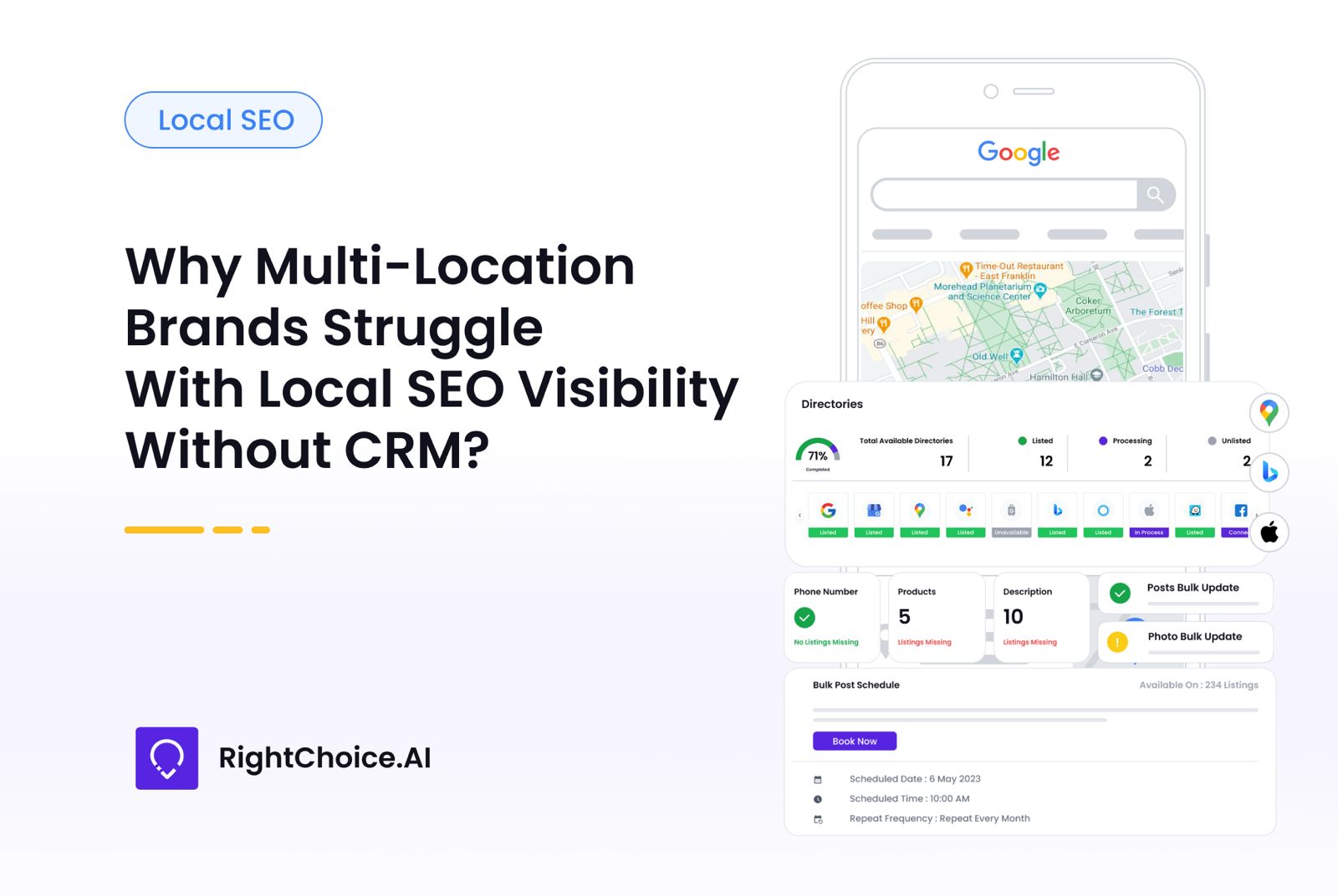
RightChoice.ai is purpose-built to address the visibility challenges inherent in multi-location operations. The platform provides a unified environment where organisations can manage, monitor, and optimise their digital presence across all locations from a single interface.
RightChoice.ai centralises critical business data, ensuring that names, addresses, phone numbers, operating hours, and categories remain accurate and consistent across platforms. This eliminates data silos and prevents conflicting updates from decentralised actions.
The platform synchronises verified information across Google, Apple Maps, Bing, and more than 20 additional directories, reinforcing trust signals used by discovery systems. Continuous monitoring alerts teams to unauthorised changes, duplicate listings, or discrepancies before they affect visibility or customer experience.
By combining automation with governance, RightChoice.ai enables multi-location brands to scale confidently with local SEO while maintaining accuracy, consistency, and brand integrity.
Centralised vs Decentralised Management: Visibility Impact Comparison
| Dimension | Decentralised Management | Centralised Management |
| Data Accuracy | Varies by location | Consistent across all locations |
| Brand Governance | Limited control | Enforced brand standards |
| Operational Efficiency | High manual effort | Automated and scalable |
| Customer Experience | Inconsistent | Predictable and reliable |
| Platform Trust Signals | Fragmented | Strong and unified |
| Review Oversight | Disjointed | Central monitoring |
| Scalability | Difficult to sustain | Designed for expansion |
Centralised visibility management is not merely an operational enhancement; it is a strategic investment. Brands that adopt a unified approach gain improved insight, faster execution, and stronger customer trust.
As discovery platforms continue to evolve toward automated verification and AI-driven understanding, the importance of consistency and authority will intensify. Multi-location brands that fail to centralise risk declining visibility and weakened competitiveness.
Conclusion
Multi-location brands face structural visibility challenges that cannot be resolved through fragmented or decentralised management models. Inconsistencies, unclear ownership, operational inefficiencies, and weakened trust signals collectively undermine discoverability and customer confidence.
Centralised management provides the foundation required to maintain accuracy, consistency, and control at scale. With platforms such as RightChoice.Ai, brands can transform visibility from a recurring challenge into a strategic advantage—ensuring that growth strengthens presence rather than dilutes it.
In an increasingly automated and competitive digital environment, centralisation is no longer optional. It is essential for sustained visibility, credibility, and long-term brand success.