Introduction
If you’ve been “optimising” your Google Business Profile (GBP) for months posting weekly, adding photos, tweaking descriptions and you still bounce around the map pack, here’s the uncomfortable truth: in 2026, most local ranking movement comes from a small set of fundamentals that Google has been consistent about for years, plus a much tougher layer of trust validation.
Google still says local results are based primarily on relevance, distance, and prominence (sometimes described as “popularity”). That hasn’t changed. What has changed is how competitive (and spammy) the ecosystem is, and how aggressively Google seems to reward businesses it can confidently classify as real, located where they claim, and genuinely chosen by customers.
So let’s cut through the noise and talk about what actually moves rankings in 2026 what to prioritise, what to stop wasting time on, and what you can realistically influence.
The 3 ranking pillars (still) decide everything
1) Relevance: “Are you the best match for this query?”
Relevance is your ability to match the intent behind a search like “AC repair near me”, “orthodontist”, or “veg restaurant”. Google’s own guidance is simple: complete and accurate business information helps it match you to searches.
In practice, relevance is mainly built from:
1. Your primary category (and a tight set of secondary categories).
Categories are not “keywords”; they are Google’s classification system. The wrong primary category can cap your visibility no matter how many reviews you have. Google’s guidelines tell you to use as few categories as possible and pick the most specific that describes your core business.
2. Your services/products setup and on-profile content that reinforces the category.
In 2026, GBP is less about “stuffing info” and more about making it obvious what you do. Add services that mirror real offerings. If you’re a “Dentist” but all your services scream “cosmetic clinic,” you create ambiguity.
3. Website alignment (entity clarity).
Google doesn’t treat Google Business Profile as a standalone asset. It cross-checks. If your profile says “Emergency Plumber” but your website has thin, generic pages with unclear location/service coverage, relevance weakens. Google’s broader ranking guidance is built around meaning, relevance and quality signals.
4. The biggest relevance unlock in competitive niches: match a specific query to a specific page. If you serve multiple services, a generic homepage often underperforms versus a clean, relevant service/location page that exactly matches what people search.
This is where RightChoice.AI create measurable impact. Instead of guessing what Google associates with your category, AI-driven profiling tools analyse:
- Category–keyword alignment
- Service coverage gaps
- Competitive content signals
- Map pack intent patterns
RightChoice.AI helps ensure your GBP and website are speaking the same language.
In 2026, that alignment is non-negotiable.
2) Distance: “How close are you to the searcher or the place searched?”
This is the pillar you can’t “SEO your way out of.” Google explicitly includes distance as a core local factor.
A few realities in 2026:
- Rankings are grid-based. You might be #2 at one street corner and #9 two kilometres away. That’s normal.
- Service-area businesses (SABs) still feel this hard: even with a wide service area, Google may prefer businesses closer to the searcher for many queries.
- You can improve your coverage, not “beat distance.” You do it by building stronger relevance + prominence so that when Google’s algorithm has options at similar proximity, you win.
What not to do: fake addresses, virtual offices, keyword-stuffed names, or misleading location signals. Apart from policy risk, these approaches tend to get caught more often as Google tightens spam enforcement (and your rankings can collapse overnight). Google also states you can’t pay or request better local rankings.
AI tools like RightChoice.AI allow businesses to:
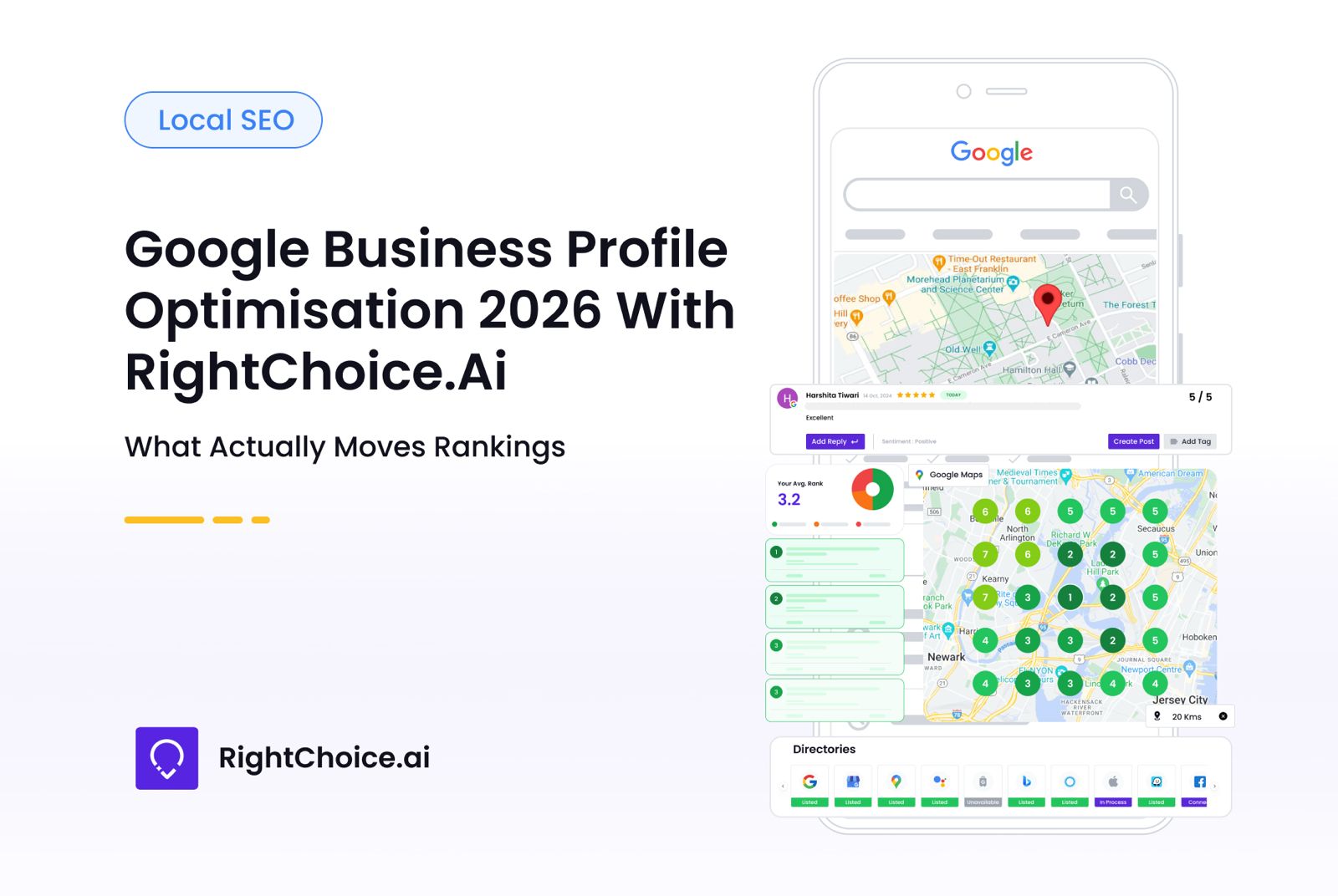
- Track rankings on map grids
- Identify weak coverage zones
- Detect competitor dominance pockets
- Optimise local landing pages accordingly
Distance cannot be manipulated but coverage strategy can
3) Prominence: “Are you well-known and trusted?”
Prominence is the reason a business can rank even if it’s slightly farther away: Google may decide it’s more likely to satisfy the search. That example is literally in Google’s documentation.
Prominence is built from:
1. Review quantity, velocity (recency), rating, and review “realness.”
Reviews remain one of the most powerful trust objects in local search.
Also, fake reviews are under brighter scrutiny, and consumer expectations around authenticity keep rising.
2. Brand mentions and authority signals across the web.
This includes local citations, press mentions, directory coverage, and links. Not all citations are equal, but consistent, legitimate references help Google corroborate that your business exists and is known.
3. On-site organic strength (still matters).
A common misconception: “GBP rankings are separate from my website SEO.” In reality, local pack performance and organic authority are heavily connected through prominence. Strong local pages, good internal linking, and real-world brand signals make Google more comfortable showing you.
4. Behavioral signals (the “did people choose you?” layer).
Google doesn’t publish a list of engagement metrics for GBP ranking, but the system is designed to show results that best satisfy users. In competitive packs, businesses that consistently earn clicks, calls, direction requests, and repeat brand searches often look like they stabilize better over time (treat this as correlation you can influence indirectly through better offers, photos, reviews, and landing pages).
RightChoice.AI helps automate review monitoring, sentiment tracking, and response optimisation without violating Google guidelines.
What actually moves rankings in 2026 (the high-impact levers)
1) Nail your category strategy (and stop “category collecting”)
If you only do one thing this week, do this: verify your primary category is the most accurate “money category.” Google’s own guidelines emphasize choosing categories that reflect your core business, not attributes or nearby businesses.
Practical approach:
- Choose one primary category that matches the service you most want to rank for.
- Add only a handful of secondaries that reflect real offerings.
- Build the rest of your profile and website to reinforce that classification.
2) Align GBP ↔ website ↔ citations (entity clarity wins)
In 2026, Google is harsher on mismatch:
- Different phone numbers across directories
- Different names (or keyword additions in one place)
- Different addresses formats
- Confusing service descriptions
Your goal is simple: make Google’s job easy. Consistency across your GBP, your website, and major listings builds confidence. Google has explicit guidelines for representing your business accurately, including consistent naming across locations for chains and the importance of real-world representation.
3) Build a review engine, not a “review campaign”
A spike of reviews followed by silence looks unnatural. What you want is a steady cadence that matches your customer volume.
What matters most in 2026:
- Recency (a living profile looks more trustworthy)
- Volume over time (consistent demand signal)
- Responses from the owner (customer care signal)
- Authenticity (avoid gating and avoid shortcuts)
4) Treat photos as conversion assets (and ranking support, not magic)
Photos rarely “rocket” rankings by themselves, but they do improve conversion, and conversion tends to support visibility over time.
Do this:
- Add real exterior/interior photos (especially helpful for “near me” decisions)
- Add service-in-action photos (proof you do what you claim)
- Keep it fresh monthly (not daily)
5) Use posts for offers and timeliness, not as a ranking hack
Posting every day is not a guaranteed ranking lever. Use posts to:
- Promote seasonal offers
- Announce new services
- Build click-through with strong CTAs
Think “marketing channel,” not “algorithm lever.”
6) Fix the “name game” the safe way
Keywords in the business name can influence relevance, but it’s also one of the fastest ways to get edits, suspensions, or competitor spam reports.
Google’s guideline is clear: your business name should reflect your real-world name, consistently used on signage and branding.
If you legitimately operate under a DBA and it’s reflected in real-world branding, fine. If you’re trying to wedge “Best Plumber in Kolkata” into your name, you’re playing with fire.
7) Build local authority off Google (because discovery is fragmenting)
Here’s the new 2026 wrinkle: discovery isn’t just “Google Search → Maps.”
That pushes prominence strategy beyond GBP:
- strong brand mentions
- consistent listings
- recognizable service pages
- credible third-party references
In other words: the businesses that are well corroborated across the web are harder to displace.
What doesn’t move rankings (or is overrated) in 2026
- Obsessing over the business description keywords. Helpful, yes. A primary driver, no.
- Posting daily as if it’s Instagram. Good for offers; not a direct “rank button.”
- Adding every possible service (especially if you don’t truly offer them). It dilutes relevance.
- Buying cheap backlinks/citations. Risky and often low-trust. Prominence needs real signals.
- Tiny micro-edits every day (hours, emojis, etc.). This can create instability without benefit.
Performance Tracking Framework: What to Measure for Ranking Growth
Optimising a Google Business Profile without measurement is guesswork. In 2026, ranking movement must be evaluated through structured tracking rather than manual searches from your office Wi-Fi. Because local results are proximity-sensitive and device-dependent, businesses need consistent monitoring across grids, keywords, and engagement signals. Tracking allows you to identify whether improvements are coming from stronger relevance, improved prominence, or simply seasonal demand shifts.
Below is a structured framework that businesses should use to monitor Google Business Profile ranking optimisation:
| Metric Category | What to Track | Why It Matters | Recommended Frequency |
| Map Pack Rankings | Grid-based rankings across service areas | Shows true visibility coverage beyond one location | Weekly |
| Primary Keyword Visibility | Rankings for core service keywords | Validates category and relevance optimisation | Weekly |
| Secondary Keyword Visibility | Long-tail and service variations | Identifies expansion opportunities | Bi-weekly |
| Review Velocity | New reviews per week/month | Signals ongoing demand and trust | Weekly |
| Review Sentiment | Keyword themes inside reviews | Strengthens topical relevance | Monthly |
| Click-Through Rate | Profile views to website/call clicks | Indicates conversion strength | Monthly |
| Direction Requests | Navigation actions | Local purchase intent indicator | Monthly |
| Photo Views | Engagement vs competitors | Supports trust and brand preference | Monthly |
| Citation Consistency | NAP uniformity across directories | Reinforces entity clarity | Quarterly |
| Website Local Traffic | Organic traffic from location-based queries | Connects GBP to on-site performance | Monthly |
This framework ensures ranking optimisation is not based on assumptions but on measurable performance movement. Businesses that track consistently are able to isolate what changes drive actual improvements rather than relying on speculation.
A simple 2026 action plan (do this in order)
- Lock categories: correct primary + 3–5 realistic secondaries.
- Audit consistency: name, address, phone, hours match across GBP + site + key listings.
- Build service pages (or strengthen them): one main service page per core offering, clearly tied to your location.
- Review cadence: set a weekly target that reflects your customer volume; respond to every review.
- Add proof: fresh photos monthly; real team/service images.
- Measure by grid: track rankings across a map grid, not just “from my office Wi-Fi.”
- Stay policy-clean: avoid name stuffing and location tricks, Google explicitly warns there’s no way to pay/request better ranking.
The Core Insight for 2026
Google Business Profile optimisation is no longer about “optimising fields.”
It is about:
Building verifiable local authority.
Google promotes businesses it can confidently classify as:
- Legitimate
- Popular
- Active
- Geographically relevant
- Consistently chosen
The algorithm rewards confidence.
Your job is to reduce ambiguity.
AI-driven platforms like RightChoice.AI help businesses:
- Diagnose ranking instability
- Identify structural weaknesses
- Scale multi-location optimisation
- Monitor competitor movements
- Strengthen AI-era discovery presence
But tools alone don’t win rankings.
Clarity + consistency + credibility do.
How RightChoice.Ai Can Help Businesses
RightChoice.Ai is an AI-powered local SEO and listing management platform that helps businesses optimise and grow their visibility across Google Business Profile and other major directories with real, measurable features. Unlike manual approaches, it uses automation and analytics to strengthen your local presence and improve ranking signals in Google’s local search ecosystem.
- Centralised Listing Management
RightChoice.Ai lets you manage all of your Google Business Profile and other business listings from one dashboard, ensuring consistent Name-Address-Phone (NAP) information and service details across multiple locations seamlessly. This helps reduce listing errors and supports better local search visibility. - AI-Driven Review & Reputation Tools
The platform includes AI review sentiment analysis and an automated review reply system to help businesses understand customer feedback and respond quickly, enhancing user engagement and strengthening trust signals that influence prominence. - Performance Tracking & Local Keyword Ranking
RightChoice.Ai provides analytics to monitor how your profiles perform in local search and Maps, including geo-grid rank tracking and local keyword rank tracking. You can see impressions, click actions, and trends over time to identify optimization opportunities. - Multi-Directory Integration
Beyond Google, RightChoice.Ai helps businesses maintain consistent information across 20+ directories including Bing, Apple, Waze, and more. This broad coverage reinforces local signals and supports broader discoverability.
The takeaway: rankings move when Google gains confidence
In 2026, “GBP optimisation” is less about clever tricks and more about building classification clarity (relevance), legitimate location signals (distance realities), and real-world trust (prominence). Google’s official framework hasn’t changed. But competition has, and the winners are the businesses that look the most verifiable on Google and beyond. And with AI tools like RightChoice.AI supporting visibility intelligence, businesses can stop guessing and start optimising strategically.